

Originally Published December 2016, Reviewed and Updated April 2026
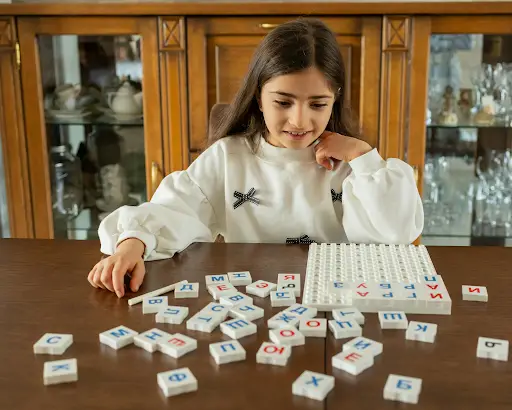
Does the weekly spelling list lead to frustration in your home? If practicing spelling words feels like a constant struggle, you’re not alone. For many children, simple memorization isn’t effective because it doesn’t match how their brains learn best.
The good news is that there’s a better way. We use a powerful strategy adapted from foundational, evidence-based programs like Lindamood-Bell that focuses on visualizing. This brain-friendly technique helps “lock” the word into your child’s memory.
Here’s how to turn spelling practice from a chore into a success story.
Step 1: How Do I Create the Mental Picture?
First, show your child the word written clearly in black, lowercase letters on a plain white card. This is important because it’s how they’ll most often see the word when reading.
Tell your child to take a “mental snapshot” of the word. Give them a few seconds to study it, then take the card away and ask them to see the word in their mind.
Step 2: How Can They Make It Physical?
Now, ask your child to use their finger to “air write” the word, saying each letter as they go. This step connects the visual image to muscle memory, creating a stronger learning pathway.
Step 3: How Do I Check Their Mental Image?
With the mental image in mind, ask a few simple questions to solidify their recall.
- “What was the first letter?”
- “What letter comes after the ‘l’?”
- “What was the very last letter?”
If they struggle to answer, that’s okay! Simply go back to Step 1 and let them take another “mental snapshot.” Remind them to use the picture in their head to find the answer.
Step 4: Why Should We Spell the Word Backward?
This is the most powerful step. Ask your child to spell the word out loud, but backward. For “play,” they would say, “y-a-l-p.”
This isn’t just a trick—it forces their brain to pull from the visual memory of the word rather than just reciting a memorized sequence. It proves they truly see the word in their mind.
Step 5: When Do They Finally Write the Word?
After they can successfully spell the word backward from their mental image, ask them to write it down on paper. This is the final step that confirms they have mastered the word.
Why This Method Works
This multi-sensory approach works because it engages sight, movement, and hearing. It helps move a spelling word from unreliable short-term memory to solid long-term memory.
If you’re looking for a good place to start, focus this strategy on high-frequency words that will give your child the most confidence, like those found on Fry’s Word Lists.
When to Seek Extra Support
If you find that spelling is a persistent and significant struggle, it might be connected to other challenges. Consistent difficulty with reading, writing, and spelling can sometimes be a sign of a learning difference like dyslexia.
Our goal is to help your child build the skills they need to become a confident and successful learner. We offer specialized academic tutoring and speech-language therapy to support your child’s unique journey.
Please contact us to schedule a consultation or to learn more about how we can help.
About the Author
Sonia Strueby, M.A., CCC-SLP, is the founder of Enrichment Therapy & Learning Center. With over 25 years of experience as a speech-language pathologist, Sonia has dedicated her career to helping children overcome complex communication and academic challenges. She has advanced training and a special focus on treating dyslexia and childhood apraxia of speech, and she is passionate about providing families with a clear path to success.

0 Comments