

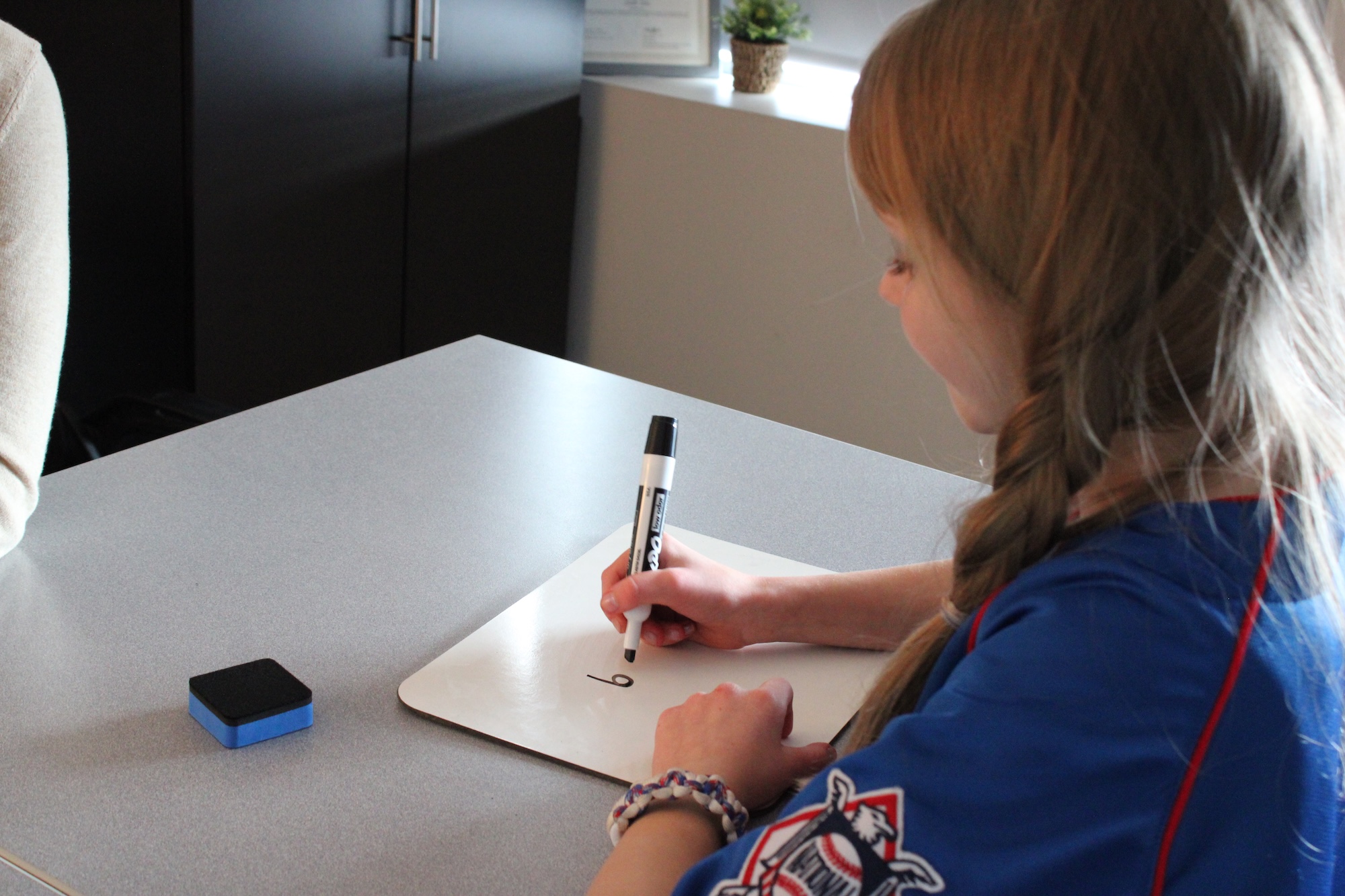
Is dyslexia just mixing up b’s and d’s? Is it reading or writing a word backward? Those can be signs of dyslexia, but dyslexia is much more than that.
Do you feel like your child is struggling, but you don’t know why? Has dyslexia crossed your mind, but you weren’t sure what it meant? October is Dyslexia Awareness Month. While dyslexia can feel scary at first, it doesn’t have to be overwhelming. This guide covers what dyslexia is, how it is evaluated, and how we can help your child succeed.
What Is Dyslexia?
Dyslexia is a type of reading disorder that affects a child’s ability to read fluently. Students with dyslexia often struggle to identify the sounds for a particular letter or to break a group of letters into parts. This affects their ability to read words and paragraphs fluently, spell words, and use words in writing.
The International Dyslexia Association describes it this way: “Dyslexia is a specific learning disability that is neurological in origin. It is characterized by difficulties with accurate and/or fluent word recognition and by poor spelling and decoding abilities.”
If you are concerned that your child may have dyslexia, it might be time for an evaluation. For more detail on what to look for, see our guide to the signs of dyslexia.
How Is Dyslexia Evaluated?
As the first step of the evaluation process, the speech-language pathologists (SLPs) at Enrichment Therapy & Learning Center give parents a questionnaire to learn more about the symptoms parents are seeing in their child.
Next, a full dyslexia evaluation is conducted. This typically includes a variety of tests and can be given by a psychologist or an SLP. The evaluation can last anywhere from 2 to 4 hours, depending on the number of areas that are assessed. Based on the results, a diagnosis of dyslexia may be made, and recommendations for dyslexia therapy will be given.
We also have resources for families who want to look at the specific areas assessed when diagnosing dyslexia.
Finding Dyslexia Success
Now what? You’ve gotten the dyslexia diagnosis, but how do you help your child? What should they be working on? While each child has their own individual needs, here are some areas that may be a focus.
Reading Accuracy
It is important to start with your child’s reading accuracy and their knowledge of vowel combinations and phonetic rules before addressing reading rate. Students must first get the technique down (accuracy), and then, as the skill becomes more natural, they can practice it with more speed (rate). Too often, reading rate is the main focus in dyslexia programs, which only creates unnecessary frustration.
At ETLC, we start by working with students on vowel combinations to build awareness of phonetic rules.
Nonsense Words and Phonetic Rules
Next, we focus on learning the phonetic (decoding) rules and applying them to real words and even nonsense words. Practicing with nonsense (not real) words is important because so many kids with dyslexia rely on guessing a word from context. While that is a smart strategy, it is not very effective and will only get them so far. When we apply the phonetic rules to words that are not real, the child can’t rely on guessing. They must use the phonetic rule to sound the word out. For instance, when a child is given the nonsense word “meab,” they have to rely on their knowledge of phonics rules to sound it out, because it isn’t a real word.
You can also download your own set of Decoding Rule Cards.
Sight and Spelling Words
Weekly sight word and spelling lists are also very important for children with dyslexia. Words that do not follow the typical rules should be targeted along with the rest. At ETLC, we use a visualizing program for sight and spelling words. Our Therapy Talks video on visualizing spelling words and our guide to mastering sight words and spelling have more.
Brain Training Activities
Some students with dyslexia benefit from other strategies, such as brain flexibility games, memory and attention games, and handwriting practice. These activities can build attention skills, working memory, and visual processing. Each level increases the difficulty by adding another mental challenge, and brains can adapt and grow.
Comprehension
What is the use of reading if your child isn’t understanding what they read? There are specific strategies that should be taught to help a child create an image in their head about what they are reading. For instance, if you were given step-by-step directions for something, you might remember the steps by visualizing yourself doing them. Many children do not automatically know how to visualize, so they need to be taught.
Many learning centers try to address comprehension by having students read paragraph after paragraph and answer questions about each one. That approach is really just assessment, and it does not give students strategies to improve their imagery. Stronger imagery skills help children retain details and main ideas, which in turn helps them answer higher-order thinking questions more accurately. Here is a look at all the ways visualizing is used at ETLC, for comprehension and for much more.
Download our free e-book for a comprehensive look at dyslexia.
Frequently Asked Questions
Is dyslexia just mixing up letters?
No. Reversing letters like b and d can be a sign, but dyslexia affects how children connect letters to sounds, which in turn affects reading fluency, spelling, and writing.
Who can evaluate a child for dyslexia?
A full dyslexia evaluation can be given by a psychologist or a speech-language pathologist. It typically takes about 2 to 4 hours, depending on the areas assessed.
Why does reading accuracy come before reading speed?
Students need to learn the technique first, which means accuracy and knowledge of phonetic rules. Speed can build once the skill feels natural. Putting speed first often only creates frustration.
How ETLC Can Help
Dyslexia is not a matter of effort or intelligence, and with the right instruction, children can make real progress. If you think your child may have dyslexia, or you have a diagnosis and want to know what comes next, our team can help. Enrichment Therapy & Learning Center has locations in Johnston and North Liberty, IA, with virtual services also available.
Learn more about dyslexia therapy at ETLC or schedule a free consultation to talk with a member of our team.
You may also find these pages helpful:
- Child Diagnosed With Dyslexia? What to Do Next
- Self-Esteem for Kids With Dyslexia: How to Help
- What Is Phonological Awareness and Why Does It Matter for Reading?
About the Author
Sonia Strueby, M.A., CCC-SLP, is the founder of Enrichment Therapy & Learning Center. With over 25 years of experience as a speech-language pathologist, Sonia has dedicated her career to helping children overcome complex communication and academic challenges. She has advanced training and a special focus on treating dyslexia and childhood apraxia of speech, and she is passionate about providing families with a clear path to success.

0 Comments