

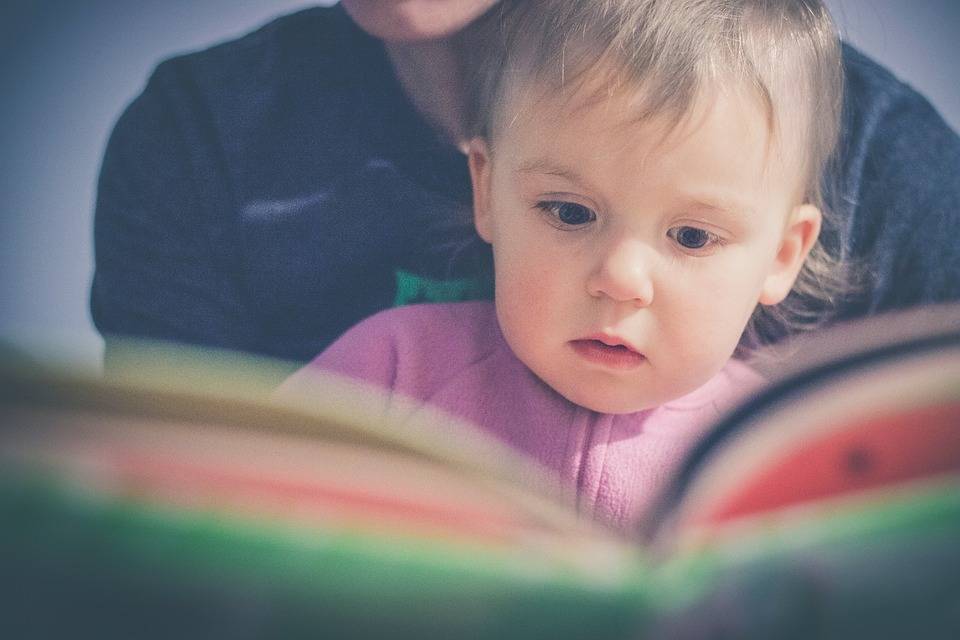
By Katherine Kline, M.A., CCC-SLP
Did you know a book has the potential to tell more than just a story for your child? Sometimes finding new ways to incorporate your child’s speech and language goal areas can be a burden for parents to create at home. Look no further than your child’s nightstand to find his or her favorite story. Not only will you use the book to work on different skills, but you will continue to enhance your child’s exposure to pre-literacy skills.
What book to choose.
I always suggest using books for their illustrations, rather than their “reading messages.” Using books that have rich and colorful pictures may make this activity more fun. The trick is, you will get to guide how you’ll use your book at home. A way that you can let your child think that he/she is the leader is to allow your child to pick the book, be the page-turner helper and enjoy mom or dad’s one-on-one time!
Target comprehension skills.

One of my favorite ways to see if a child truly understands the book is by playing “Socrates.” Ask those “5-WH questions” of WHO (“Who is this?”), WHAT (“What is that?” or “What are they doing?”), WHERE (“Where is XX?”), WHEN (“When did XX go home? Before or after?”) and WHY (“Why is he crying?”) questions while reading or looking at pictures in a book.
By asking these simple questions, you are looking further in-depth at your child’s knowledge of vocabulary by labeling, prepositions by answering those “where” questions, sequential information by asking “when” questions, and inferential knowledge by asking “why!”
Target speech skills.
For those of you who may have a child that struggles with certain speech sounds, a book offers a more fun and interactive way of practicing speech sound productions. For example, if your child is working on “s,” a great idea could be to find a book with snow scene pictures and say all the “s” words (snow, stomp, scarf, sled, skate, sing, snowman…etc).
You might also use books for picture description tasks (“Tell me what’s going on in this photo.”) for children working on their fluency strategies (for children who stutter), storytelling (“First XX, then XX, last XX”), or working on generalizing articulation goals to longer sentences!
Target grammar.
Books also provide wonderful tools to target sentence structure, pronoun use, verb tense agreements…etc.
Look at the picture below:

Notice that we are not paying attention to any words! The picture becomes your main “therapy tool.” Use pictures for inspiration of pronouns (“Is this a girl or boy? Is it a he or she?”), helping-verb agreement (“She IS xx.” vs. “They ARE xx.”), irregular past tense (“They just sat down.” vs. “They talked to each other.”) or expand sentences and number of words your child uses!
As you can see—the options are limitless. Of course, you can use the book for the “boring” purpose of reading. But I urge you to look beyond the type and make the book interactive and fun! It can be done! If you have any questions about your child’s speech or language skills, or if you’re concerned about their performance, you can contact us here.
________________________________________________________________________________
Enrichment Therapy & Learning Center has locations in Johnston and North Liberty, IA, with virtual services also available. We provide individualized speech-language therapy, dyslexia and reading intervention, academic support, and executive functioning services to help children build skills and confidence. Contact us to learn more about how we can support your child.


0 Comments