

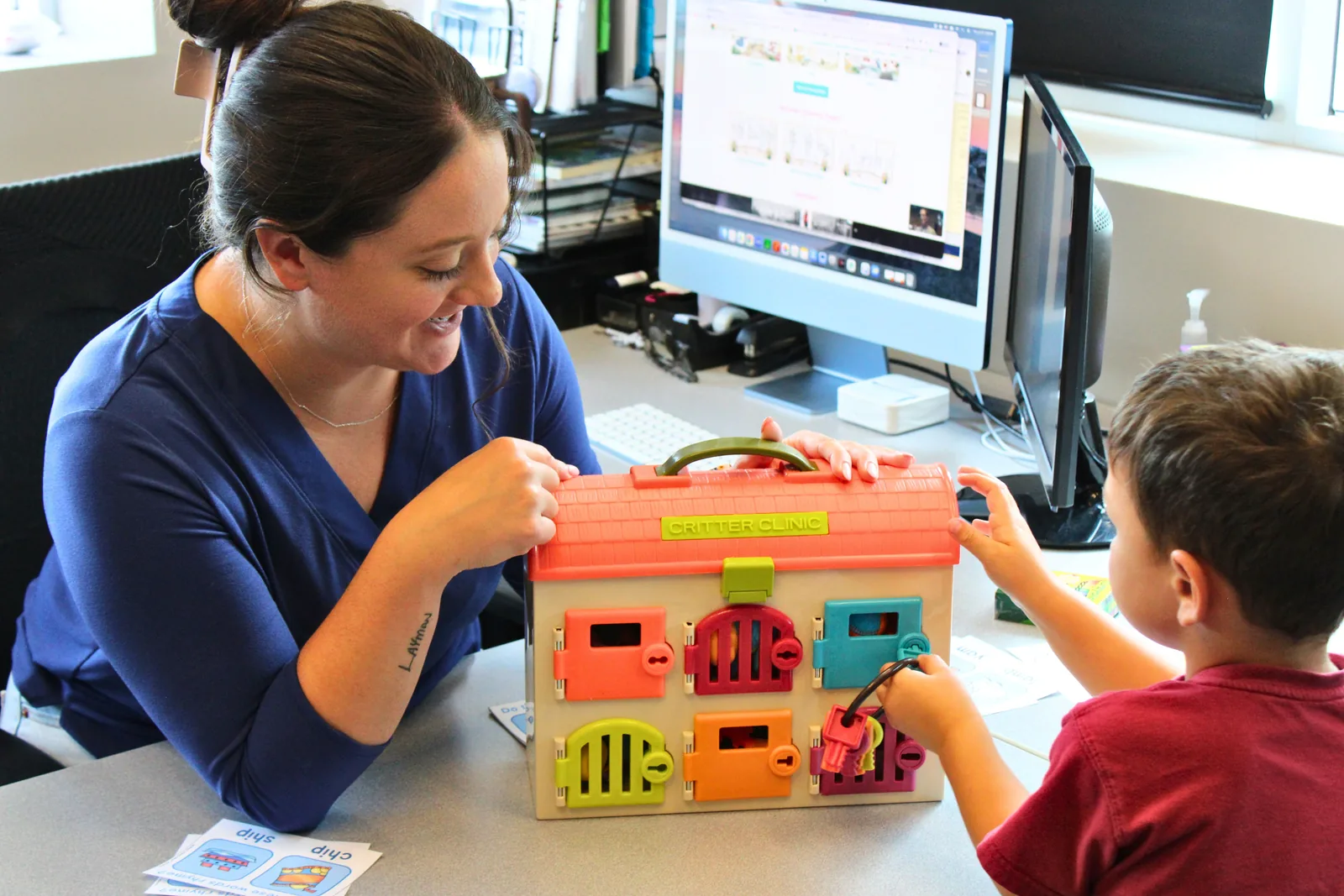
“I don’t know if he doesn’t understand me, or if he’s just not listening.”
If you’ve said this, you are not alone. It’s one of the most common things parents tell us, and it’s one of the most important questions to answer. The strategies to help your child follow directions are very different for a child who doesn’t understand than for a child who understands but isn’t attending.
As speech-language pathologists, our first step is always to find out whether a child can understand the spoken direction. The good news is that you can practice, and learn a lot about what is going on, through playful, low-pressure activities.
This guide covers how to practice following directions at home in a way that’s engaging and effective, how to build up to multi-step directions, and how to teach children to understand and answer WH questions: who, what, where, when, why, and how.
Why Following Directions Matters
Following directions is a core receptive language skill, meaning the ability to understand and process what others say. It underlies almost everything a child is asked to do in a classroom: listen to the teacher, complete assignments, participate in group activities, and navigate social situations.
Children who struggle with following directions often aren’t choosing to ignore. They may be missing words, losing track of the steps, or struggling to hold the information in working memory long enough to act on it. Identifying which of these is the challenge is the first step toward helping.
How to Practice Following Directions at Home
The key to effective direction-following practice is making it feel like play, not a test. Here are three approaches that work well across a range of ages and ability levels.
Do Something Silly
Children are often more motivated to follow a direction when it leads to something unexpected and fun. Instead of “put your shoes by the door,” try:
- “Can you roll the play dough into a ball and put it on your nose?”
- “Can you hop like a bunny to the couch and then roar like a lion?”
- “Put the teddy bear on your head and walk to the kitchen.”
- “Can you put the blue block on your head?”
Silly directions catch children off guard, generate laughter, and make them want to follow along. They also reveal comprehension in a low-stakes, enjoyable way. A silly command doesn’t feel like a chore, so listening becomes part of the fun instead of a demand.
Use Motivating Activities
Children attend better when directions involve things they care about. Build direction practice into activities they already love:
- In a craft: “Get the green crayon and color the frog’s legs.”
- Around a holiday: “Find the biggest present and bring it here!”
- Outside: “Run to the big tree and bring me one leaf.”
- While cooking: “Get two eggs from the fridge and put them on the counter.”
The more meaningful the context, the more motivated your child will be to listen carefully and respond accurately. When children want to do the activity, listening to the directions becomes a natural part of reaching their goal.
Join In and Model
When you participate alongside your child, you can model what following a direction looks and sounds like. While coloring together, try: “Look, I’m going to get the purple crayon and color the princess’s hair. Now, can you get the red crayon and color her crown?”
While building a tower, try: “I’m putting the red block on top. Can you find a yellow block and put it on the tower next?”
Modeling before asking your child to attempt the direction reduces the performance pressure and gives them a clear example to follow. When you play together, you’re a teammate, not a taskmaster.
Building Up to Multi-Step Directions
Children develop the ability to follow increasingly complex directions over time. A general progression looks like this:
- One-step directions, such as “Get your cup.”
- Two related steps, such as “Get your cup and bring it to the table.”
- Two unrelated steps, such as “Clap your hands and then touch the door.”
- Three steps, then four or more, as your child shows success at each level
One important rule: make sure your child waits until they’ve heard the entire direction before beginning. Children who start acting on the first step often miss the second and third, and practicing waiting before moving is a skill in itself.
Simon Says
Simon Says is a classic for good reason. It naturally builds in listening before acting, and the “Simon Says” rule requires children to monitor each direction carefully.
Three-step examples:
- “Simon says: stand up, clap your hands, and turn in a circle.”
- “Simon says: touch your head, pick up the ball, and sit down.”
Four-step examples:
- “Simon says: tap your knees, touch your nose, clap your hands, and take a drink of water.”
- “Simon says: say your name, turn in a circle, bounce the ball once, and sit down.”
Five-step example:
- “Simon says: put the pillow on the bed, turn in a circle, hop on one foot, lie down, and clap your hands.”
Can You Draw That?
Give your child a blank piece of paper and a set of crayons. Give directions one at a time:
- “Draw a big blue circle in the middle of the page.”
- “Draw a small red triangle above the circle.”
- “Color the triangle orange.”
This game targets following directions while also reinforcing colors, shapes, spatial concepts, and fine motor skills, so you get multiple goals in one activity.
Household Tasks
Everyday tasks make excellent multi-step direction practice because they’re meaningful and naturally motivating. Try:
- “Go to your room, get your dirty clothes, and put them in the hamper.”
- “Get the cereal from the cabinet, put it on the table, and then get a bowl.”
- “Fill the dog’s water bowl, put it on the mat, and then wash your hands.”
When children follow directions as part of real household routines, the skill tends to carry over more quickly to school and other settings.
How to Teach WH Questions
WH questions are some of the most important language skills a child develops. They underlie conversation, reading comprehension, and the ability to learn from instruction.
Children develop the ability to answer different question types in a predictable sequence. In general, concrete questions such as who, what, and where tend to come first, and questions that need more reasoning, such as when, why, and how, come later.
If your child consistently struggles with a question type that should be emerging for their age, that’s worth targeting directly.
How to Assess WH Questions at Home
Pick one question type and ask your child ten questions of that type using pictures, books, or everyday objects. If they answer 8 out of 10 correctly, that question type is solid, so move on. If they answer fewer than 8, that’s a good target to work on.
Strategies for Teaching WH Questions
Structured Picture Card Tasks
Use picture cards (store-bought or homemade) and ask the same question type repeatedly. For what’s-doing questions, use action pictures: “What is she doing? What is he doing?” The repetitive, visual format makes it easier for children to build confidence with a new question type before applying it in less structured contexts.
Books
Choose books that naturally lend themselves to a target question type and ask that question repeatedly throughout the story. For where questions, books where a character visits different locations work well: “Where is Pete now? Where did he go next?” The predictable repetition helps children internalize the question form.
Play
Generalize WH questions into natural play:
- Hide a toy and ask, “Where is the bunny?”
- Have animal figures do actions and ask, “What is the elephant doing?”
- Look at a scene and ask, “Who is wearing a hat?”
The more varied the contexts where your child practices answering questions, the more automatic the skill becomes.
Frequently Asked Questions
How do I know if my child is ignoring me or doesn’t understand?
Try a simple one-step direction during play, such as “Put the block on the table.” If your child follows it when it is fun and clear but not at other times, attention or motivation may be involved. If they struggle even with easy directions, understanding may be the issue.
What are signs of a receptive language problem?
Signs can include trouble following one- or two-step directions, answering questions that do not match what was asked, and relying on gestures or watching others to figure out what to do. A speech-language evaluation can tell you what is going on.
At what age should my child follow multi-step directions?
Skills build gradually. Many toddlers follow simple one-step directions, and older preschoolers and school-age children manage more steps at a time. If you are unsure whether your child is on track, a screening can give you a clear answer.
How do I know if my child’s difficulty following directions is a language issue or an attention issue?
It often takes a professional evaluation to sort out. If your child follows directions better one on one in a quiet setting than in a busy one, attention may be a factor. If they struggle equally in both and also have trouble with vocabulary or longer sentences, language is likely involved. Often both are present.
My child follows simple directions at home but not at school. Why?
Classroom directions are often longer, given in a group with background noise, and delivered at a faster pace. A child who is at the edge of their ability at home may not have enough capacity left for a more demanding environment. Building complexity at home helps create that buffer.
What if my child understands the question but gives an off-topic answer?
This can happen with word retrieval difficulty, not fully processing the question, or not yet knowing what type of information the question asks for. Practice naming what each question word is “looking for”: “When means a time, like morning, afternoon, or tonight.”
Should I repeat directions when my child doesn’t follow them?
Resist the urge to repeat or rephrase right away. Wait five to ten seconds first, since some children need extra processing time. If they still don’t respond, simplify the direction rather than repeating it at the same length.
How ETLC Can Help
Following directions and answering questions are language skills, not behavior choices. When they are hard, a child can look like they are not listening. If your child consistently struggles, especially in school settings, our team can help find out whether a language evaluation is the right next step. Enrichment Therapy & Learning Center has locations in Johnston and North Liberty, IA, with virtual services also available.
Learn more about language disorder support at ETLC or schedule a free consultation to talk with a member of our team.
You may also find these pages helpful:
About the Author
Sonia Strueby, M.A., CCC-SLP, is the founder of Enrichment Therapy & Learning Center. With over 25 years of experience as a speech-language pathologist, Sonia has dedicated her career to helping children overcome complex communication and academic challenges. She has advanced training and a special focus on treating dyslexia and childhood apraxia of speech, and she is passionate about providing families with a clear path to success.


0 Comments