


Does your child have difficulty understanding math concepts? You are not alone. According to The New York Times, 64% of fourth graders were not scoring at a proficient level in math in 2022. It is important to make sure your child can succeed, but it can be hard to figure out how to help a child struggling with math. Luckily, a few simple strategies and tools can make a big difference.
Help Your Child Visualize Math Concepts
First, use manipulatives, number lines, hundreds charts, blocks, and other tools to help your child see what numbers and math concepts look like. Building a child’s number sense is essential for success with math, and our guide to number sense explains how.
Make Learning Multisensory
When you bring in as many senses as you can (sight, hearing, touch, and movement), you will likely notice a deeper understanding of the math concept. For example, have your child say an addition sentence aloud while writing it in the air with a finger: “3 + 5 = 8.” Then have them show the problem with colored blocks, using 3 red blocks plus 5 blue blocks to make 8 blocks in all.
Make Math Real
Show your child how the concepts they are learning apply to real life.
- While you shop, ask your child to estimate the total cost as you fill the cart, or bring a calculator and have them total the items.
- If your child is struggling with fractions, pull out a recipe and start baking. For an extra challenge, double the recipe and have your child figure out how much of each ingredient you need.
For more ideas, see our post on everyday activities that build math skills.
Five Math Manipulatives and How to Use Them
Children learn best when they are interested in the material, and manipulatives keep them engaged. When children can touch and experience math concepts, they better understand what the numbers and symbols represent. Here are five of our favorites.
1. Dice
Dice come in many shapes and sizes, with numbers or dots on each face. For children learning computation, have them roll two dice and add, subtract, multiply, or divide the two numbers facing up. You can also buy blank dice and write the numbers your child needs to focus on. For example, if your child is practicing division facts in the 2s family, write multiples of 2 on the faces. They roll one die and divide that number by 2. For an extra challenge, add a timer and a recording sheet to see how many facts they can answer in one minute. To see how we practice early math with dice and board games, watch our Therapy Talk.
2. Colored Cubes
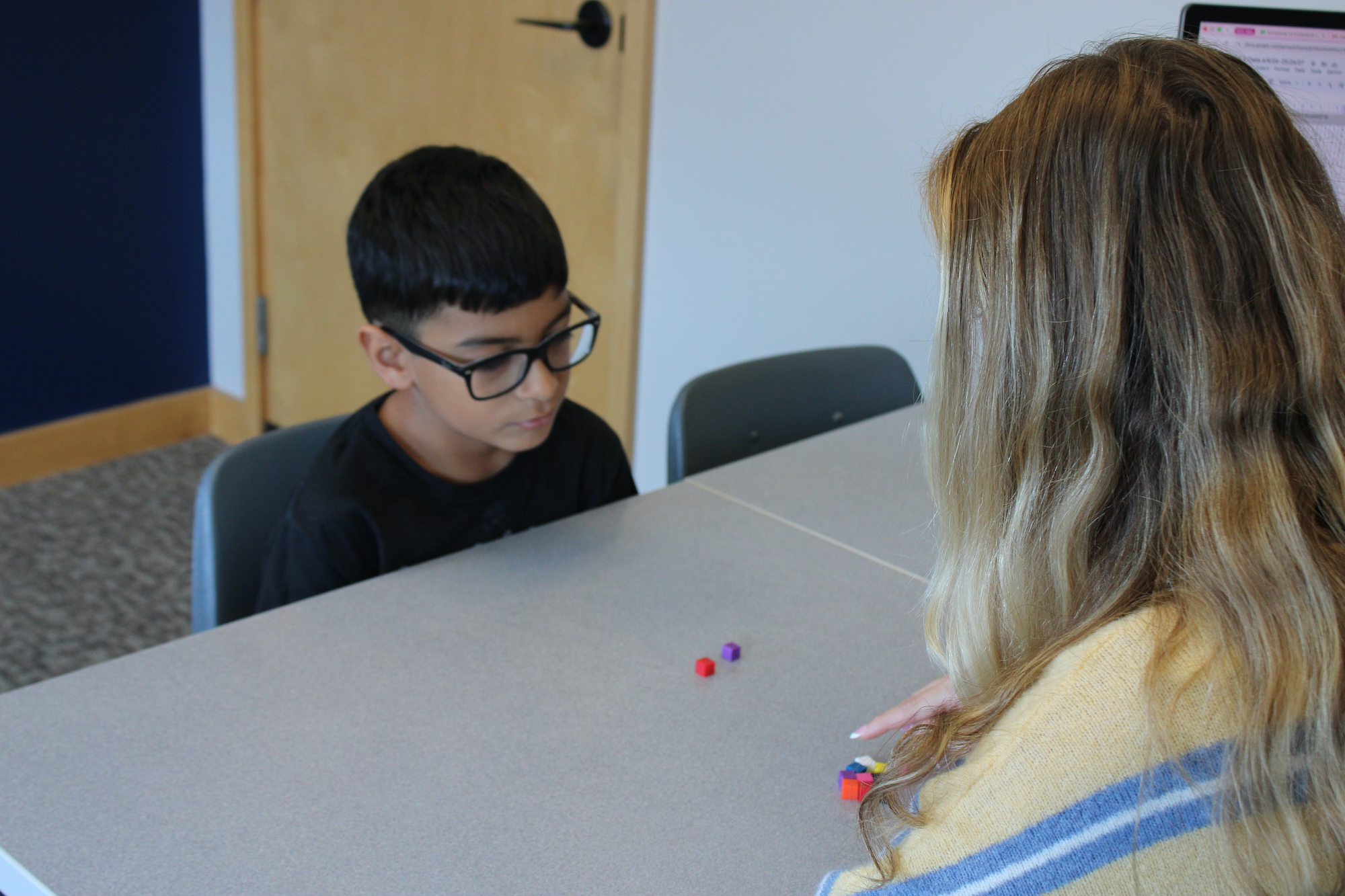
Colored cubes work for many different abilities and activities. To visualize addition, write a math fact on paper and ask your child to build it with cubes, using one color for the first number and another for the second. For the total, stack the two colors together. You can also use cubes for patterns. Create a pattern of colors and have your child continue it, or make stacks of 2, 4, and 6 cubes and ask for the stack that comes next.
3. Play Money
Set up a school store at home. First, save empty grocery items such as cereal boxes and milk jugs, label each with a price, and display them on a table so your child can go shopping. Then, with task cards, children can practice counting money, giving change, staying within a budget, finding the cost per item, and comparing prices to find the best buy.
4. Fraction Tiles
Fractions are hard to grasp from numbers alone. It is difficult to see why 1/2 is greater than 1/5, but with fraction tiles, the difference is obvious. Tiles also help with equivalent fractions. If you give your child 2/3 and ask for an equivalent fraction, they can line up 4/6 to see that the two are equal.
5. Base Ten Blocks
Base ten blocks represent hundreds, tens, and ones, which makes them ideal for teaching place value. First, make a simple place value chart and ask your child to show 258. Next, they place 2 hundreds blocks in the hundreds column, 5 tens blocks in the tens column, and 8 ones blocks in the ones column. Also, the same chart and blocks help children see what carrying and borrowing look like in multi-digit addition and subtraction. Once they have mastered the blocks, they can visualize the steps in their heads and complete problems on paper.
Consider Extra Support for Math
Because students who are having a hard time with math may need support outside of school, a tutor or learning specialist can do a full assessment to find the underlying reason your child is struggling. At ETLC, we identify the foundational skills your child has not yet mastered and build an individualized plan to help them succeed.
Frequently Asked Questions
How do I know if my child needs extra help with math?
Watch for signs that effort is not turning into progress. Your child may still count on fingers well past the early grades, avoid math homework, or understand a concept one day and lose it the next. If you notice a pattern that continues despite practice at home, an assessment can show which foundational skills are missing.
Are manipulatives only for young children?
No. Tools like fraction tiles and base ten blocks are often most useful in upper elementary grades, when concepts such as fractions and multi-digit operations become abstract. Many students keep using them until they can picture the problem in their heads.
What if my child says they hate math?
Strong feelings about math are often tied to anxiety or to missing foundational skills, not a lack of ability. To help, praise effort instead of correct answers, keep practice short and playful, and see our guide to building math skills at home, which includes tips for tackling math anxiety.
How ETLC Can Help
If your child is struggling with math, our team can help find out why and build a plan that fits how your child learns. Enrichment Therapy & Learning Center has locations in Johnston and North Liberty, IA, with virtual services also available.
Learn more about tutoring and academic support at ETLC or schedule a free consultation to talk with a member of our team.
You may also find these pages helpful:
- Fun Ways to Build Math Skills at Home
- What Is Number Sense and Why Is It Important?
- Practice Math Facts at Home: A Visualization Trick
About the Author
Sonia Strueby, M.A., CCC-SLP, is the founder of Enrichment Therapy & Learning Center. With over 25 years of experience as a speech-language pathologist, Sonia has dedicated her career to helping children overcome complex communication and academic challenges. She has advanced training and a special focus on treating dyslexia and childhood apraxia of speech, and she is passionate about providing families with a clear path to success.

0 Comments