

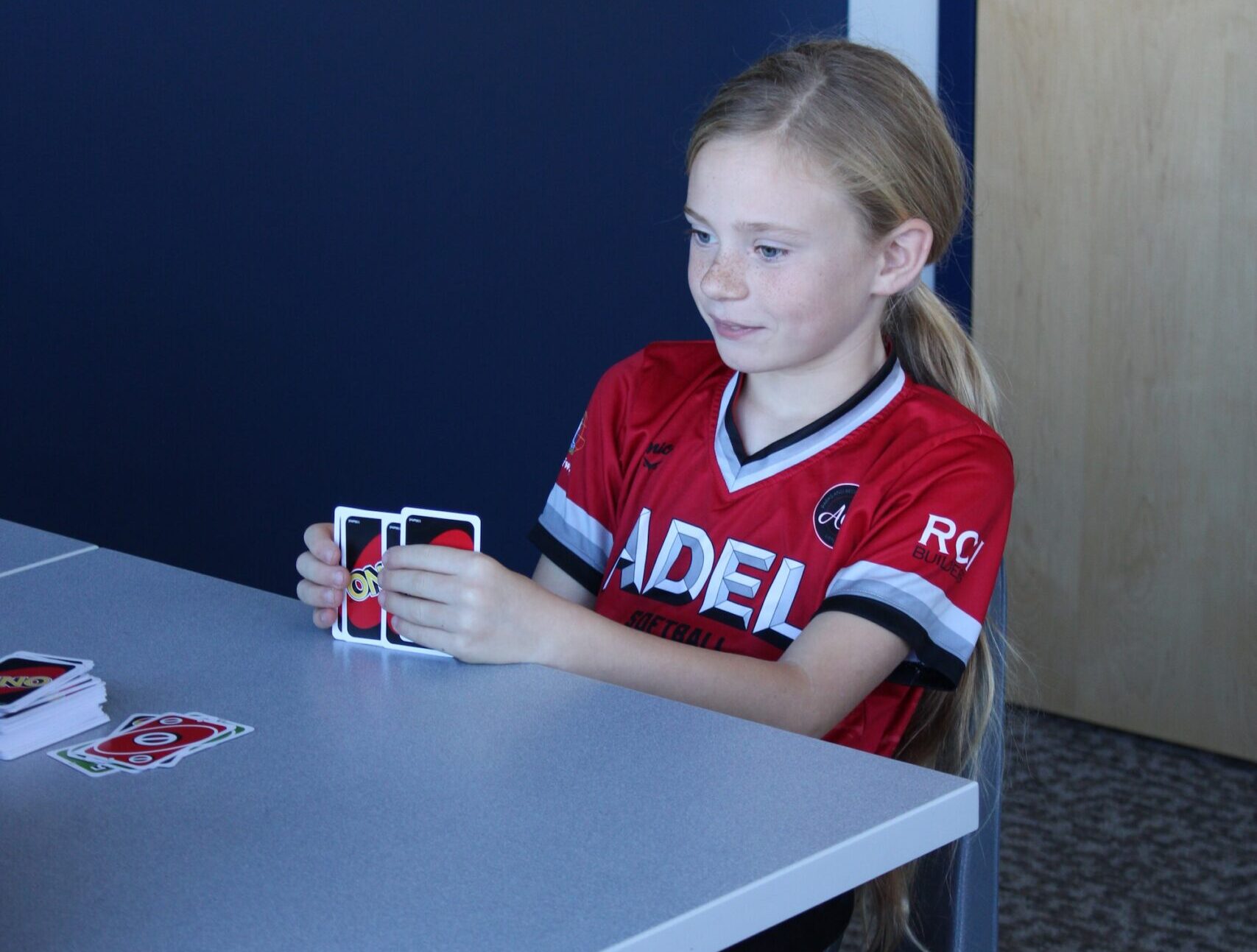
Are you looking for a way to connect as a family without a screen? Family game night offers more than entertainment, because it can also build language and communication skills while you make lasting memories. If you want to start your own family game night tradition, or breathe new life into an existing one, here are 8 games we recommend, plus more game ideas by age that also make good holiday gifts. For more on the benefits, check out this article from Cornell.
Why Is Family Game Night Good for Language Development?
Games create a natural, low-pressure place where children practice communication skills before they realize they’re learning. Playing board games can help children build vocabulary, practice turn-taking, improve listening skills, and learn to express themselves clearly. Through gameplay, kids work on:
- Vocabulary: exposure to new words and concepts
- Conversation: forming questions and talking with others
- Listening: auditory processing and listening comprehension
- Expression: describing, explaining, and storytelling
- Social skills: turn-taking and following rules
8 Games Speech-Language Pathologists Recommend
1. Guess Who?
A classic for a reason. As players take turns asking yes or no questions, they narrow down and guess their opponent’s secret character.
- Ages: 5+
- Skills: formulating questions, turn-taking, and descriptive language
2. Headbanz
Each player wears a headband with a secret picture, and then asks questions to figure out what it is.
- Ages: 7+
- Skills: asking questions, categorization, memory, and describing details
3. Blurt!
When one player reads a definition, everyone else races to blurt out the correct word.
- Ages: 7+
- Skills: vocabulary, quick word retrieval, and auditory processing
4. Tapple
This is a beat-the-clock word game. Players must name something in a category that starts with an available letter before the timer runs out.
- Ages: 8+
- Skills: categorization, vocabulary, and letter-sound knowledge
5. Quiddler
In this card game, players make words from the letter cards in their hands, and the words get longer as each round goes on.
- Ages: 8+ (a Junior version is available for ages 6+)
- Skills: spelling, vocabulary, and phonological awareness
6. Rory’s Story Cubes
After players roll the picture dice, they make up a story that connects all the images.
- Ages: 8+
- Skills: storytelling, sentence structure, sequencing, and imagination
7. Catchphrase
In this fast-paced electronic game, players try to get teammates to guess a secret word by describing it before the timer buzzes.
- Ages: 8+
- Skills: vocabulary, synonyms, describing, and word retrieval
8. Scattergories
Once players roll a letter, they come up with unique answers for a list of categories that start with that letter.
- Ages: 13+
- Skills: creative thinking, categorization, and vocabulary
More Game and Gift Ideas by Age
If you’re stumped on what to give a child for the holidays or a birthday, these games are also good picks. Some were chosen with children who struggle in school in mind, but they work for any child.
Ages 3 to 5
- Zingo: A Bingo-style game where kids match the picture tiles on their cards, so it builds vocabulary and quick word recall.
- What’s Gnu?: Players use letter tiles to build three-letter words, which gives early readers practice with word recognition and spelling.
Ages 6 to 7
- Qwirkle: While players match colors and shapes to build rows, they also plan ahead and use strategy.
- Blokus: This strategy game has one rule: each piece must touch another piece of the same color, but only at the corners.
- Bananagrams: This fast word game has players race to build a word grid, and it also travels well.
- Cranium Cadoo: This kids’ activity game has silly challenges that get children thinking, creating, and laughing.
- The Scrambled States of America: This geography game, based on Laurie Keller’s story, uses riddles and visual clues to teach about the 50 states.
- Rush Hour: This sliding car puzzle has challenge cards, so it works on planning and problem-solving.
Math, Logic, and Vocabulary Games
- Sequence Numbers: This is a good fit for children working on addition and subtraction, since equations are on the cards and the answers are on the board.
- Sum Swamp: This beginner game for addition and subtraction can help build confidence when children are learning early math.
- Brainbox Math: Children study a card on this cube of math activities, then flip it and answer questions from memory.
- Mastermind: Players use logic and reasoning to create and break codes, and they must think ahead.
- Apples to Apples Junior: When players compare cards and choose which best fits a given word, they build vocabulary and thinking skills.
How to Make the Most of Family Game Night
If you choose any of these games, you get quality time together and a play-based way to practice language. For more ideas, Confident Connections has simple tips for practicing social skills during game night. To get the most out of game time:
- Model: Show good sportsmanship and communication.
- Explain: Encourage your child to explain their thinking out loud.
- Ask: Use open-ended questions about strategies and choices.
- Celebrate: Praise effort, not just winning.
- Relax: Keep it fun and pressure-free, because learning happens naturally through play.
Frequently Asked Questions
What age should we start playing board games?
Many children can start with simple games around age 3. Pick games that match your child’s age and attention span, and then move up as they grow.
What if my child gets upset when they lose?
This is common because losing takes practice. Start with short games, talk about being a good sport before you play, and praise your child’s effort.
Can games replace therapy?
No. Games are a fun way to practice at home, but they don’t replace therapy. If you have concerns about your child’s speech or language, a speech-language pathologist can help.
How ETLC Can Help
If you have concerns about your child’s speech, language, or learning, our team is here to help. Enrichment Therapy & Learning Center has locations in Johnston and North Liberty, IA, with virtual services also available.
Learn more about speech-language therapy at ETLC or schedule a free consultation to talk with a member of our team.
You may also find these pages helpful:
- Build Language Skills During Play: A Therapist’s Guide
- Games for Executive Functioning: Fun Ideas by Age
- Language Disorders
About the Author
Sonia Strueby, M.A., CCC-SLP, is the founder of Enrichment Therapy & Learning Center. With over 25 years of experience as a speech-language pathologist, Sonia has dedicated her career to helping children overcome complex communication and academic challenges. She has advanced training and a special focus on treating dyslexia and childhood apraxia of speech, and she is passionate about providing families with a clear path to success.

0 Comments