
Originally Published December 2016, Reviewed and Updated April 2026
As a speech therapist, one of my favorite things is watching that “aha!” moment when a new word finally clicks for a child. For many toddlers, learning colors is an exciting milestone. But for some, connecting a color to its name can be tricky, leaving parents wondering if they’re teaching it the “right” way.
The good news? You absolutely can. The secret isn’t flashcards, but a few simple strategies that make learning feel like play.
Connect Colors to Their Favorite Things
The best way to teach a new concept is to connect it to something your child already knows and loves. This gives their brain a “hook” to hang the new information on. Instead of just repeating “blue,” you anchor it to a familiar object.
- Think about your child’s current obsession:
-
- Food: “An apple is red.”
- Characters: “Bluey is blue.”
- Toys: “Your favorite car is yellow.”
- Label and link during playtime:
-
- “Look! Your banana is yellow! Yum, yellow banana.”
- “Let’s use the green block. Green like the grass!”
- Use that connection as a bridge:
-
- “This ball is red—just like your apple!”
- “Your shirt is blue—the same color as Bluey!”
Make It Playful and Hands-On
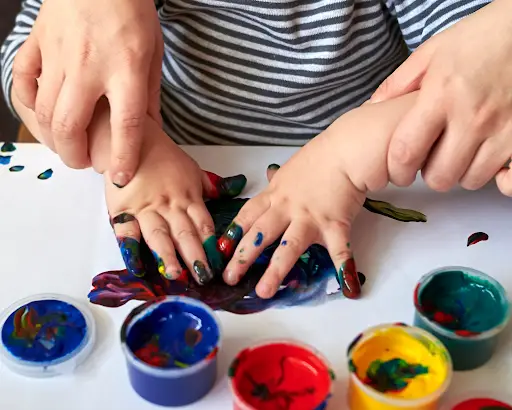
Children learn best when they’re moving and doing. Weaving color practice into your daily routine is far more effective than structured lessons.
- During everyday moments:
- Getting Dressed: “Do you want your red socks or your blue socks?”
- Snack Time: “Let’s eat the green grapes first!”
- On a Walk: “I see a yellow flower. Can you find something else that’s yellow?”
- Try a simple game:
- Color Hunts: Place colored construction paper on the floor and have your child find toys that match each color.
- “I Spy”: A classic for a reason! “I spy with my little eye… something green.”
Want more activity ideas tailored to your child’s interests? Learn about our speech-language pathologists and contact our team to discuss personalized color learning strategies based on your child’s unique needs and preferences.
Be Patient and Keep It Positive
Remember, every child learns at their own pace. Some kids will pick up colors in a week, while others might take a few months. While this is completely normal, understanding typical speech and language development milestones can provide helpful context for your child’s journey.
Your role is to be a patient, encouraging guide. Keep the activities low-pressure and fun, and celebrate the small wins. The more positive the experience, the more your child will learn.
Frequently Asked Questions
At what age should my child know colors?
Most children begin to understand color concepts between 18 months and 2 years old, though they may not be able to name colors yet. By age 3, many children can correctly identify and name at least one color, and by age 4-5, most can name multiple basic colors. However, every child develops at their own pace. If you have concerns about your child’s speech and language development, our team can help assess whether your child is meeting typical developmental milestones.
How long does it take to teach colors?
There’s no set timeline—some children grasp colors in a few weeks, while others may take several months. The key is consistent, playful exposure rather than pressure. Focus on one or two colors at a time, using the connection strategies outlined above. If your child seems to struggle significantly or shows frustration, consider reaching out to our speech-language pathologists, who can provide personalized strategies tailored to your child’s learning style.
What if my child isn’t learning colors?
First, remember that color learning varies widely among children. However, if your child is over 4 years old and still can’t identify any colors, or if they seem confused despite consistent practice, it may be worth exploring further. Sometimes difficulty with colors can be related to vision issues, so a vision screening is a good first step. Additionally, children with speech and language delays may need extra support. Contact our team to discuss whether a speech-language evaluation might be beneficial for your child.
What order should I teach colors in?
Start with primary colors that appear frequently in your child’s environment: red, blue, and yellow are great starting points. Many children also learn colors connected to their favorite things first—if your child loves bananas, yellow might click before blue! Focus on one or two colors at a time until your child masters them, then gradually introduce others. Our therapists can help create a customized learning plan based on your child’s interests and developmental needs.
When should I be concerned about my child not knowing colors?
While color recognition develops at different rates, consider seeking professional guidance if your child is 4 years or older and cannot identify any colors consistently, shows significant frustration during color activities, or has other speech and language concerns. Our experienced team specializes in childhood communication development and can determine if your child would benefit from speech therapy services to support their overall language growth.
____________________________________________________________________________
About the Author
Sonia Strueby, M.A., CCC-SLP, is the founder of Enrichment Therapy & Learning Center. With over 25 years of experience as a speech-language pathologist, Sonia has dedicated her career to helping children overcome complex communication and academic challenges. She has advanced training and a special focus on treating dyslexia and childhood apraxia of speech, and she is passionate about providing families with a clear path to success.



0 Comments