

When snow days keep coming, kids are stuck inside and probably bouncing off the walls. I’m all for a true snow day to relax, play, and enjoy a day off. But as these days add up, kids can miss out on school and even speech and language therapy sessions. Here are snow day activities that are fun and secretly educational, for inside and outside.
Outdoor Snow Day Activities: Build a Snowman
If it’s a true snow day and not just a cold day, head outside to enjoy the snow. You can work on following directions by giving your child step-by-step instructions for building a snowman. For younger kids, keep them simple, like “Put a hat on top of the snowman.” For older kids, make them more complicated, such as “Put a hat on top of the snowman and then find two sticks for the arms.”
If your child is working on temporal directions, then use words like before and after. For example, say, “Before you put the eyes on the snowman, give him a carrot nose,” or “Wrap a scarf around the snowman’s neck after you give him 3 buttons.”
Indoor Snow Day Activities: Make a Snowman Craft
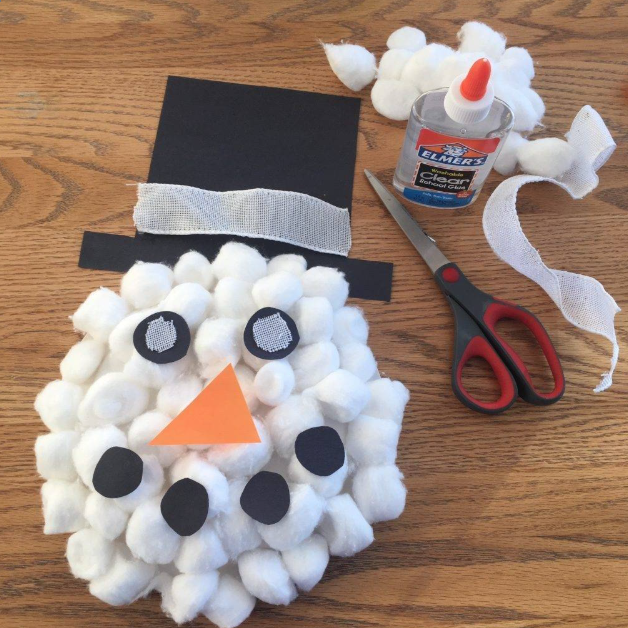
If you’re stuck inside, then try this snowman craft. For younger kids, give instructions one step at a time and help as needed. For older kids, use “before” and “after” and then combine steps, so that they have to complete them in the order of the directions.


What You’ll Need
- Paper plate
- Cotton balls
- Orange and black construction paper
- Ribbon
- Glue
- Scissors
- 5 to 6 buttons (optional)
- Googly eyes (optional)
Steps
- Flip the paper plate over and glue cotton balls to cover the entire surface.
- Cut out an orange triangle for the carrot nose and glue it to the middle of the face.
- Then glue two eyes above the nose.
- After that, create a smile with the buttons and glue it below the nose.
- Next, cut out a hat from black paper and attach it with glue on the back edge of the plate and the bottom front of the hat.
- Cut ribbon to the length of the bottom of the hat above the brim and attach it with glue.
More Indoor Snow Day Activities: Make Snow Dough
This easy science experiment is sure to entertain kids of all ages. You will need:
- 16 oz. corn starch (put it in the freezer overnight to make it extra cold and “snowy”)
- About 10 oz. unscented body lotion (put it in the refrigerator overnight to make it cold)
- Optional: a couple drops of peppermint extract
- Optional: iridescent glitter
- Pipe cleaners, pom poms, sticky eyes, and any other embellishments you have on hand
First, pour the corn starch into a large mixing bowl. Next, add the lotion, plus the peppermint extract and glitter if you like. Then mix with your hands until it forms together like play dough, which usually takes a minute or two of kneading. That’s it! Roll three spheres, stack them together, and add embellishments to make a snowman, or use cookie cutters to make holiday shapes. Also, this dough is for play, not for eating, so supervise young children closely.
Practice Language by Visualizing the Snowman
Once you make your snowman, real or craft, you can practice language and memory skills by visualizing it. First, download the helpful handout on visualizing below, and then download the 7 structure words for younger kids.
Next, practice describing the snowman you created with the structure words. Encourage your child to close their eyes and picture the snowman in their head. Then go inside, or hide the craft snowman, and have your child describe the snowman from memory. After your work is done, curl up with a cup of hot cocoa and a good book.
Frequently Asked Questions
How can I keep my child learning with snow day activities?
Choose short, hands-on activities, like a craft or a science experiment. Because they feel like play, kids often practice following directions and describing without noticing.
What is visualizing, and why does it help?
Visualizing means making a picture in your mind. Also, it supports memory, vocabulary, and comprehension, since children can use the picture to describe and remember what they heard or read.
When should I talk to a speech-language pathologist?
If your child struggles to follow directions, find words, or describe things even with practice, then a consultation can help you decide if an evaluation makes sense.
How ETLC Can Help
Snow day activities are a great chance to build skills at home, and our team can help if your child needs more support. Enrichment Therapy & Learning Center has locations in Johnston and North Liberty, IA, with virtual services also available.
Learn more about speech-language therapy at ETLC or schedule a free consultation to talk with a member of our team.
You may also find these pages helpful:
- Holiday Language Activities: Build Speech and Language Skills This Season
- Family Game Night Ideas for Building Language Skills
- Tutoring and Academic Support
About the Author
Sonia Strueby, M.A., CCC-SLP, is the founder of Enrichment Therapy & Learning Center. With over 25 years of experience as a speech-language pathologist, Sonia has dedicated her career to helping children overcome complex communication and academic challenges. She has advanced training and a special focus on treating dyslexia and childhood apraxia of speech, and she is passionate about providing families with a clear path to success.
0 Comments