

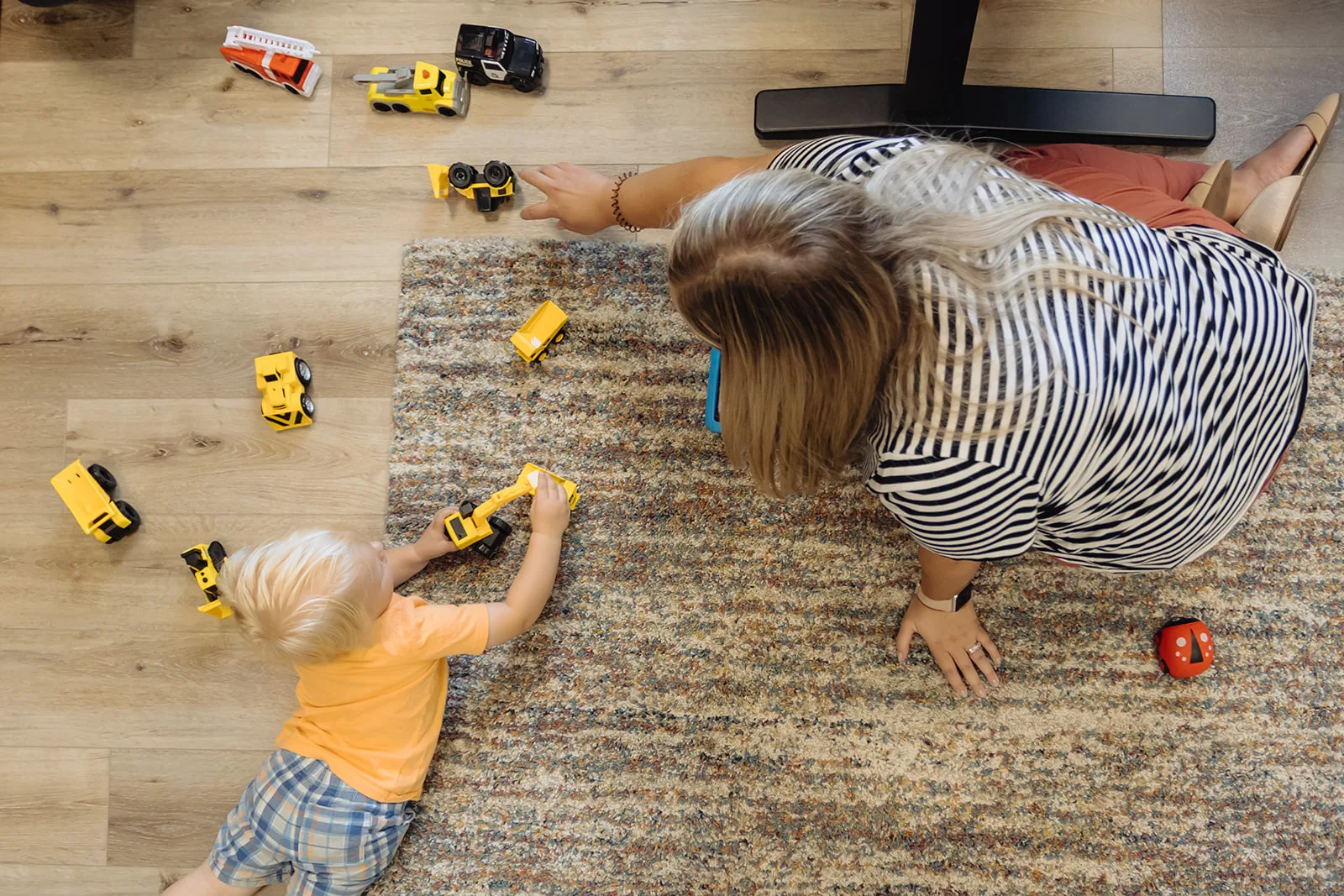
What if one of the most powerful things you could do for your child's development didn't require any special materials, any training, or any appointments — just you, your child, and twenty minutes on the floor?
That's the core idea behind Floortime. It's a relationship-based intervention that uses play — specifically, play led entirely by your child — as the vehicle for building connection, communication, and emotional development. And while it was originally developed for children with autism, its principles are valuable for any child who struggles with engagement, attention, or back-and-forth interaction.
What Is Floortime?
Floortime — formally called the DIR/Floortime model (Developmental, Individual-Difference, Relationship-Based) — was developed by child psychiatrist Stanley Greenspan, M.D., and developmental psychologist Serena Wieder, Ph.D. It is a naturalistic, play-based intervention built on one central idea: that emotional connection and joyful interaction are the foundation from which all other development grows.
Unlike behavioral approaches that focus on teaching specific skills through direct instruction and reinforcement, Floortime focuses on building the emotional and communicative relationship between a child and their caregiver — and trusts that targeted skills will follow from that foundation.
The name comes from the practice of literally getting down on the floor — to your child's physical level — and entering their world.
How Does Floortime Work?
The practice of Floortime is built around a deceptively simple idea: follow your child's lead.
Following the child's lead doesn't just mean doing what they do. It means following their emotions — paying close attention to what your child is interested in, what pleases them, what captures their attention — and using that to draw them into shared interaction.
Here's what that looks like in practice:
Observe first. Before jumping in, watch what your child is doing and notice what seems to engage or delight them. Are they spinning a wheel? Lining up blocks? Looking at light patterns? Their activity is your entry point.
Join in without redirecting. Get physically down to their level and enter the activity on their terms — not yours. If they're rolling a car back and forth, you roll a car back and forth too. Don't immediately try to change the activity, add rules, or turn it into something educational. Just join.
Follow their emotional lead. Match their energy, their interest, and their affect. If they're excited, be excited with them. If they're calm and focused, be calm and focused alongside them.
Create gentle opportunities for interaction. Once you're in their world, look for natural openings to create a moment of connection — a look, a gesture, a shared laugh, a simple exchange. You might playfully block the car's path or add your car to the road. Not to redirect, but to create an invitation.
Build circles of communication. In Floortime, each back-and-forth exchange — a look, a gesture, a word, a shared action — is called an "opening and closing a circle of communication." The goal is to open as many circles as possible within the session and to gradually support your child in opening circles themselves.
The Six Milestones of Floortime
Greenspan and Wieder identified six developmental milestones that form the foundation of healthy emotional and communicative development. Floortime targets these milestones in sequence, meeting the child wherever they currently are and supporting growth to the next level.
1. Self-Regulation and Interest in the World
The child can remain calm and regulated enough to take in and engage with what's happening around them. This is the foundation — without it, none of the other milestones are accessible.
2. Engagement and Intimacy
The child shows warmth, pleasure, and interest in connecting with another person. They look at you, smile at you, and enjoy your presence.
3. Two-Way Communication
The child engages in back-and-forth exchanges — gestures, expressions, actions, and eventually words — in a reciprocal, intentional way.
4. Complex Communication
The child can chain together longer, more complex sequences of communication — problem-solving, expressing needs, and interacting around a shared goal.
5. Emotional Ideas
The child begins to use words, play, and symbols to represent ideas, feelings, and experiences — the beginning of pretend play and emotional expression through language.
6. Emotional Thinking
The child connects ideas logically and emotionally — understanding cause and effect, distinguishing fantasy from reality, and developing empathy and reflective thinking.
Who Is Floortime For?
Floortime was originally developed for children with autism spectrum disorder, and it remains one of the most well-supported relationship-based approaches for this population. It is particularly valuable for children who:
- Struggle with joint attention — looking at something together with another person
- Have difficulty initiating or sustaining back-and-forth interaction
- Are more interested in objects than people
- Have limited or emerging language
- Seem to exist in their own world rather than a shared one
But the principles of Floortime benefit a much wider range of children — including those with language delays, sensory processing differences, social communication challenges, and children who simply haven't had enough of this kind of rich, child-led interactive play in their lives.
Any child who lights up when a caregiver enters their world and follows their lead is a child who can benefit from Floortime.
How to Practice Floortime at Home
One of the most powerful aspects of Floortime is that parents are not passive recipients of the therapy — they are the primary agents. Therapists teach parents the principles and coach them in sessions, but the intervention happens at home, during the dozens of daily play opportunities that parents are already having with their children.
Start with 20 minutes. Set aside two to three dedicated Floortime sessions each day, each about 20 minutes long. Put away your phone, turn off the TV, and give your child your full, undivided presence.
Get down low. Physically get to your child's level — on the floor, at the table, wherever they are. This isn't just symbolic — it makes you visually accessible and signals that you're entering their space.
Let go of the agenda. This is the hardest part for many parents. There's no goal for the session — no skill to teach, no behavior to correct, no lesson to deliver. Your only job is to follow your child's lead and look for opportunities to connect.
Be playfully obstructive. One of the most effective Floortime techniques is creating small, gentle obstacles that require the child to interact with you to get what they want. If they want the car to roll, your hand is in the way. If they want more bubbles, you hold the wand but look at them, waiting. These moments create the need for communication — and they do it in a way that feels like play, not demand.
Celebrate every circle. Every time your child makes eye contact, offers you something, responds to your gesture, or initiates any kind of exchange — celebrate it. Not with over-the-top praise, but with genuine delight: "You gave me the car! My turn — now you!"
Frequently Asked Questions
Is Floortime the same as ABA therapy? No. Floortime and ABA (Applied Behavior Analysis) are different in their philosophical foundations and methods. ABA focuses on teaching specific, observable behaviors through structured reinforcement. Floortime focuses on building the emotional relationship and developmental foundations from which skills naturally emerge. Both have research support; some children benefit from one, some from the other, and some from elements of both.
My child doesn't seem interested in playing with me. Will Floortime still work? This is exactly the situation Floortime is designed for. The key is finding the entry point — the activity, object, or sensory experience that does capture your child's attention — and entering that, rather than trying to pull your child into an activity they don't choose. Even very withdrawn children typically have something that engages them, and Floortime begins there.
How is Floortime different from just playing with my child? Typical play often involves adults directing the activity, asking questions, and teaching concepts. Floortime is more intentional — you are specifically following the child's lead, staying tuned to their emotional experience, and looking for opportunities to build circles of communication. The goal isn't just to have fun (though that matters) — it's to use the play as a vehicle for connection and development.
Can speech-language therapy incorporate Floortime principles? Absolutely. Many SLPs trained in naturalistic, relationship-based intervention integrate Floortime principles into their sessions and coach parents to use them at home. If this approach resonates with you, ask your child's therapist whether it can be incorporated into your child's plan.
Where can I learn more about Floortime? Dr. Greenspan's book Engaging Autism is the foundational parent resource. The ICDL (Interdisciplinary Council on Development and Learning), the organization Greenspan founded, also provides training resources, practitioner directories, and parent materials at icdl.com.
How ETLC Can Help
If your child struggles with engagement, connection, or early communication — or if you'd like guidance on how to incorporate Floortime principles into your daily interactions — our team is here to help.
Learn more about our Early Intervention services orschedule a free consultation to talk with a member of our team.
You may also find these pages helpful:
About the Author
Sonia Strueby, M.A., CCC-SLP, is the founder of Enrichment Therapy & Learning Center. With over 25 years of experience as a speech-language pathologist, Sonia has dedicated her career to helping children overcome complex communication and academic challenges. She has advanced training and a special focus on treating dyslexia and childhood apraxia of speech, and she is passionate about providing families with a clear path to success.


0 Comments