

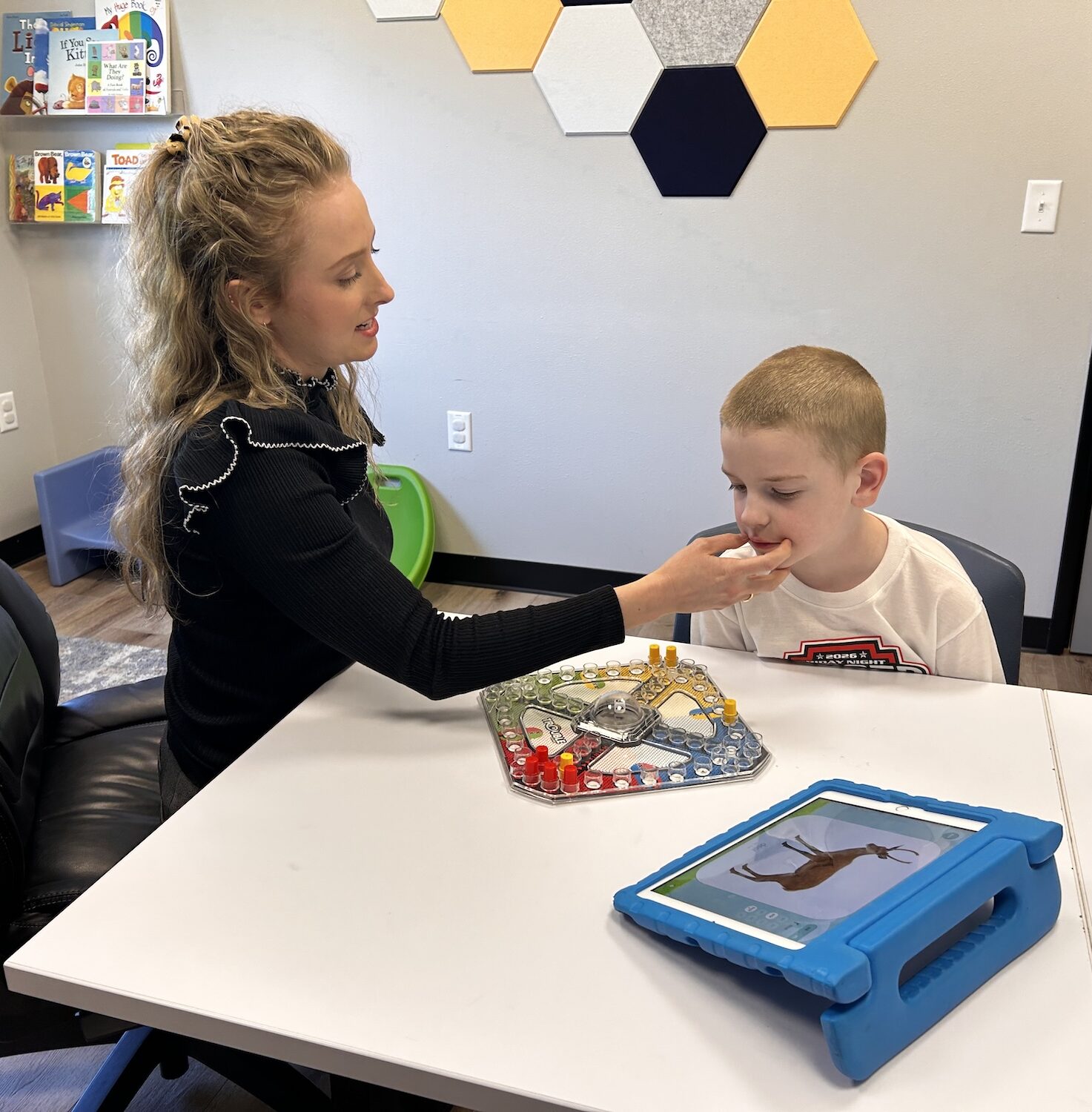
If your child is difficult to understand or has been diagnosed with a motor speech disorder like apraxia, you may be looking into PROMPT speech therapy. PROMPT is one of the specialized techniques used at Enrichment Therapy & Learning Center, so this guide answers the most common questions parents have about this hands-on approach.
What Is PROMPT Speech Therapy?
PROMPT is a technique that speech-language pathologists use to help children with speech production disorders. It uses touch cues on the child’s face, including the jaw, lips, and tongue, to guide their muscles through the movements needed to make sounds. Because it is a tactile-kinesthetic approach, it helps the child feel how sounds are made.
What Does PROMPT Stand For?
PROMPT stands for Prompts for Restructuring Oral Muscular Phonetic Targets. In practice, that means a speech-language pathologist uses specific touch cues on a child’s face and jaw, which gives the child physical, real-time feedback about how to position their mouth for a sound, word, phrase, or sentence.
How Does PROMPT Therapy Work?
When a PROMPT-trained therapist uses their hands to apply gentle pressure to a child’s face, they guide the jaw, lips, and tongue into the right positions for a target sound, word, or phrase. This physical guidance can help a child build the motor control and sequencing for speech, which is especially helpful for children who struggle to feel or plan those movements on their own.
According to the PROMPT Institute, the approach also looks beyond motor speech alone. It takes a child’s physical, cognitive-linguistic, and social-emotional development into account when planning treatment.
See PROMPT in Action
If you would like to see it, watch this short video where Jaimi Bird, M.A., CCC-SLP, shares more about PROMPT and how we use it in sessions.
What Can PROMPT Help With?
PROMPT can be used with a range of communication disorders, and it is especially helpful when a child has a motor speech disorder. Examples include:
- Childhood apraxia of speech: Childhood Apraxia of Speech (CAS)
- Articulation: severe articulation disorders and phonological disorders
- Dysarthria: weak or hard to control speech muscles
- Language: some expressive language disorders
- Limited speech: children who are nonverbal or have very limited spoken language
Why Might My SLP Use PROMPT With My Child?
There are many effective approaches to treating speech sound and expressive language disorders, and no single technique works best for every child. Since PROMPT-trained clinicians are on staff, your speech-language pathologist has another tool to choose from. They can then pick the approach, or the mix of approaches, that best fits your child.
Your child’s therapist may suggest PROMPT if your child is working on motor speech planning, if your child has a CAS diagnosis or is being evaluated for one, or when your child could benefit from added touch feedback to build clearer, more consistent sounds. If you’re curious whether PROMPT could help your child, it’s a good question to bring to your next session.
Why Is Specialized Training Required?
PROMPT is a precise technique, so it requires specialized training. Speech-language pathologists earn certification through the PROMPT Institute. Training is only open to licensed, master’s-level speech-language pathologists, and the process includes several steps:
- Introductory course: first, an overview of assessment and treatment planning
- Practicum: then, supervised use of the technique with a real client
- Advanced training: next, deeper work on comprehensive assessment
- Certification project: finally, a project that requires a high level of accuracy in assessment, technique, and treatment planning
Because of this, parents should never try the technique without proper training.
Frequently Asked Questions
Does PROMPT hurt?
No. The touch cues are gentle, and your child’s therapist will watch how your child responds. If your child is uncomfortable, tell your therapist right away so they can adjust.
Can PROMPT be used with other approaches?
Yes. Our speech-language pathologists often combine PROMPT with other methods when it fits your child’s needs.
How do I know if PROMPT is right for my child?
The first step is an evaluation. After that, your child’s speech-language pathologist can look at how your child makes sounds and suggest the approaches that may help.
How ETLC Can Help
Several of our speech-language pathologists at Enrichment Therapy & Learning Center are PROMPT-trained, and they combine this technique with other methods to meet your child’s specific needs. If you think your child could benefit from our speech-language therapy services, the first step is a comprehensive evaluation. We have locations in Johnston and North Liberty, IA, with virtual services also available.
Learn more about speech sound disorder therapy at ETLC or schedule a free consultation to talk with a member of our team.
You may also find these pages helpful:
About the Author
Sonia Strueby, M.A., CCC-SLP, is the founder of Enrichment Therapy & Learning Center. With over 25 years of experience as a speech-language pathologist, Sonia has dedicated her career to helping children overcome complex communication and academic challenges. She has advanced training and a special focus on treating dyslexia and childhood apraxia of speech, and she is passionate about providing families with a clear path to success.

0 Comments