

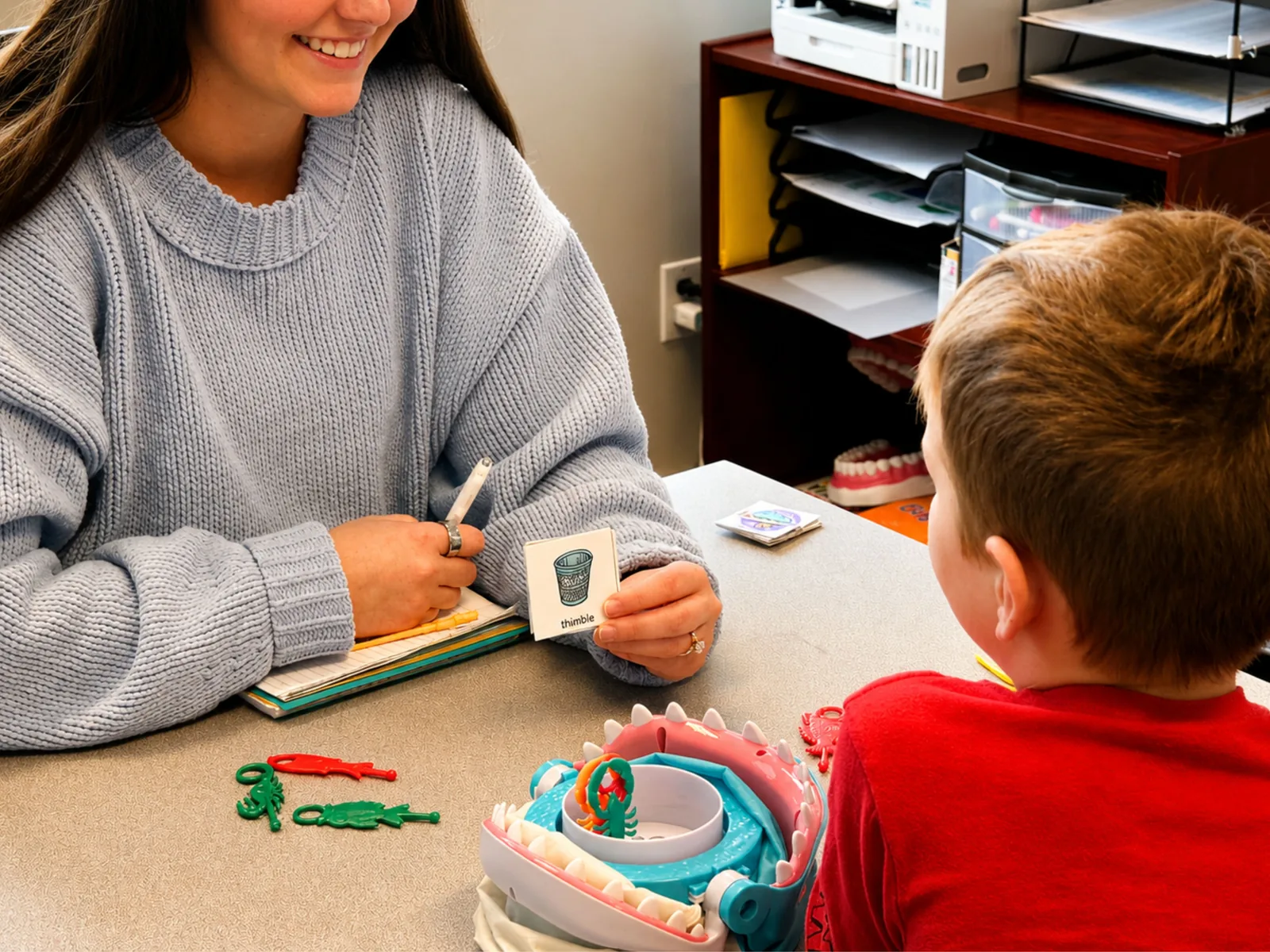
Play is the most natural learning environment a child has. It's where they practice communication, build vocabulary, develop social skills, and make sense of the world around them — all without realizing they're doing any of it.
If your child is working on speech and language skills, the good news is that you don't need special materials or structured lessons to support their progress at home. Some of the most powerful language-building happens during ordinary play — with toys you already own, in moments you're already sharing.
Here's how to make the most of them.
Five Core Strategies for Building Language During Play
1. Narrate Everything
Talk about what you're doing, what your child is doing, and what you're both seeing. Use short, simple, grammatically accurate sentences — and repeat them often.
If you're playing with balls: "My ball. Red ball. Go ball. Give me the ball." If you're building with blocks: "Up, up, up. Big tower. It fell!" If you're playing with animals: "The bunny is hopping. He's going into the barn. Night night, bunny."
Narrating doesn't require your child to respond — it simply floods their environment with language connected to what they're experiencing. Over time, children begin to use the same words and phrases they've heard repeatedly in context.
2. Use Parallel Talk
Parallel talk means describing what your child is doing as they do it — like a sportscaster calling their play.
If your child rolls a car: "The car goes fast!" If they put a toy in a box: "In the box! You put it in!" If they knock over a tower: "Boom! It fell! You knocked it down!"
This strategy helps children understand that their actions have words that go with them — and it models exactly the language they need to eventually say those things themselves.
3. Take Turns
Turn-taking in play is one of the earliest foundations of conversation. Every time you and your child trade roles in a game — you push the car, then they push the car — you're practicing the back-and-forth structure that underlies all communication.
Narrate the turns as you go: "My turn. I'm feeding the baby. Your turn! You feed the baby." This makes the pattern explicit and gives your child the language to participate.
4. Create Unexpected Moments
Set up small surprises during play that invite your child to communicate. A few easy ways to do this:
- Remove the batteries from a favorite toy before play. When it doesn't work, your child will likely react — that's your opening: "Oh, it's broken! What do we need? Help! We need help."
- Put a desired toy out of reach or in a container that's hard to open. Wait for your child to signal they want it, then model the language: "You want it? Say 'help, please!'"
- Make a purposeful mistake during play and see if your child notices: "The bunny is going up the slide" (when he's clearly going down). Watch for the correction — and celebrate it when it comes.
These small moments of communication pressure, handled warmly, are some of the most powerful language-building opportunities there are.
5. Read Together Every Day
Books are language goldmines. They introduce new vocabulary, model sentence structure, and give children repeated exposure to the same words and phrases.
While reading:
- Point to pictures and name what you see
- Ask simple questions: "Where's the dog? What is he doing?"
- Pause before repeated phrases and let your child fill them in: "Brown bear, brown bear, what do you ___?"
- Talk about what's happening: "He looks sad. Why do you think he's sad?"
Every book you read together expands your child's vocabulary and gives them another model of how language works.
Building Language With Everyday Toys
Bubbles
Bubbles are one of the most universally loved and linguistically rich activities for young children — especially those working on early sounds.
For speech: The words most naturally used during bubble play — pop, bubble, more, blow, up, please — are loaded with early-developing sounds (/p/, /b/, /m/). Before blowing more bubbles, ask your child to say one of these words. Blowing bubbles also naturally encourages lip rounding, which supports good articulation of many sounds.
For language: Take turns blowing and popping. Before you blow more, make eye contact with your child's "ticket" — "Show me your eyes!" — then reward it with more bubbles. This builds joint attention, turn-taking, and requesting. Model phrases like "more please," "my turn," "blow the bubbles up high."
Directions to try: "Pop the little bubbles." "Stomp on them." "Pop one with your nose." "Clap them between your hands."
Puzzles
Puzzles offer a structured, focused activity that naturally creates repeated opportunities to request, respond, follow directions, and build vocabulary.
For speech: Before receiving each puzzle piece, your child says their target sound, word, or phrase. For example, if they're working on /k/: "Can I have another piece?" Match the demand to their level — a sound in isolation, a single word, or a full sentence.
For language: Use each piece as a chance to build vocabulary — talk about its color, shape, size, and what it shows. Give directions: "Find the long green vegetable" or "Put that piece next to the red one." Encourage requesting: "more," "more piece please," "I want that one."
Blocks
Blocks are one of the most flexible language toys available — and most families already have them.
For speech: Have your child say a target word or sound each time they place a block on the tower. "Block." "On." "Up." Or write pictures of target-sound words on small stickers and put one on each block — your child names the picture before placing it.
For language: Work on spatial concepts (on top, under, next to, between), describing (big red block, tiny blue one), counting, and sequencing (first the red one, then the blue one). Build requesting: "more blocks," "I want a big one." And let the tower fall — "Down! It crashed!" — because the crash is often the most motivating moment of the whole game.
Ball Games
Ball play is excellent for children who need movement built into their learning — and it's easy to layer language on top.
For speech: Each time your child passes or throws the ball, they produce their target sound or word. Or alternate spelling a sight word — one letter per throw, back and forth.
For language: Give directions before each pass: "Roll it to me, then clap three times." Set up a simple bowling game with household items (paper cups, stuffed animals, empty boxes) and place vocabulary cards or direction cards under each "pin."
Prepositions Through Play
Spatial concepts — in, on, under, next to, behind, in front of, on top of — are a common area of difficulty for young children, and play is the most natural place to teach them.
Narrate location during play: "The bunny wants to go down the slide. He's climbing up the stairs. Now he's at the top. Watch him slide all the way down to the bottom!"
Make a purposeful error: "The tiger is going up, up, up the steps" (when he's clearly going down). Wait to see if your child catches it. If not: "Hmm, that's not right. He didn't go up — he went…?"
Play hide and seek with a toy: Hide a small figurine, then ask: "Where is the dog? Is he under the table? Behind the chair? On top of the box?" After your child finds it, ask: "Where was he?!" and help them use the right preposition to describe it.
Science Experiments
If your child loves science, experiments are a surprisingly rich opportunity for social and language development — especially for older children working on social skills like requesting, compromising, and giving feedback.
- Requesting help: "I need help finding the baking soda."
- Compromise: "You add the vinegar, and I'll hold the balloon."
- Giving compliments: "That was a great idea to mix those."
Simple kitchen experiments — baking soda and vinegar volcanoes, color-mixing with water and food dye, building structures from marshmallows and toothpicks — require just a few materials and create natural opportunities to communicate, collaborate, and problem-solve.
Frequently Asked Questions
How much time do I need to set aside for language practice? You don't need to carve out extra time — the strategies in this guide work during play you're already doing. Even 10 to 15 minutes of intentional, engaged play each day makes a meaningful difference over time.
My child just wants to play independently. How do I get them engaged with me? Follow their lead. Join whatever they're already doing rather than redirecting to an activity of your choosing. Sit nearby, comment on what they're doing without demanding a response, and let them come to you. Pressure to interact often backfires — but a curious, available parent usually gets invited in eventually.
What if my child isn't talking yet? Can these strategies still help? Absolutely. These strategies support language development at every level — from children who are pre-verbal to those who are starting to combine words. Narrating, taking turns, and creating communication opportunities all build the foundation that talking eventually grows from.
How do I know if my child needs more than just at-home practice? If your child is significantly behind speech and language milestones for their age, seems frustrated by communication, or isn't making progress despite consistent practice, it's worth talking to a speech-language pathologist. Early support is always more effective than waiting.
How ETLC Can Help
If you have questions about your child's language development or want to explore whether additional support might help, our team is here.
Learn more about our Early Intervention services orschedule a free consultation to talk with a member of our team.
You may also find these pages helpful:
About the Author
Sonia Strueby, M.A., CCC-SLP, is the founder of Enrichment Therapy & Learning Center. With over 25 years of experience as a speech-language pathologist, Sonia has dedicated her career to helping children overcome complex communication and academic challenges. She has advanced training and a special focus on treating dyslexia and childhood apraxia of speech, and she is passionate about providing families with a clear path to success.


0 Comments