
Sonia Strueby, M.A., CCC-SLP — Originally Published: January 2017 | Updated: August 31, 2026
Speech and language games don’t have to mean flashcards at the kitchen table. Some of the best language-building moments happen during car rides, family game nights, and lazy summer afternoons, no materials required.
Whether you’re stuck in traffic, planning a road trip, or looking for screen-free activities at home, these games naturally build the vocabulary, listening, memory, and communication skills your child is working on every day.
Car Speech and Language Games
Car rides are one of the most underused practice opportunities families have. There are no distractions, no toys to fight over, and a captive audience. Here are games organized by age that work beautifully on the road.
For Younger Children (Ages 3–6)
Rhyming. Give your child a word and ask them to think of as many rhyming words as they can, real or made-up. “Cat, bat, hat, mat, zat, prat!” Silly nonsense words count and are secretly great for phonological awareness.
I Spy. A classic for good reason. Take turns giving clues: “I spy with my little eye something… red.” To build more language, expand the clue: “I spy something red, smooth, and very fast.” Have your child ask yes/no questions to narrow it down.
Alphabet Game. Find the letters of your child’s name on signs, billboards, and license plates. Once that’s mastered, find all 26 letters in order from A to Z.
Search for Your Sound. If your child is working on a specific speech sound, take turns spotting objects that contain it. Working on /r/? Find a tree, a road, a red sign, a store. Working on /s/? Look for a stop sign, a street, or a school. Keep score if your child enjoys the competition.
For Elementary-Age Children (Ages 6–10)
Story Building. One person starts a story with a single sentence. Each person in the car adds the next sentence, taking the story in whatever direction they choose. Encourage creativity, silliness, and unexpected twists. This activity builds narrative language, vocabulary, sequencing, and sentence structure, and creates memories that last long after the trip.
I Am Going on a Picnic. The first player says: “I am going on a picnic and I’m bringing apples” (something starting with A). The second player repeats that and adds a B item. Continue through the alphabet, each player must remember everything that came before. This builds working memory, vocabulary, and phonemic awareness simultaneously.
Mileage Countdown. Pick a milestone mileage (every 50 miles, for instance) and do a family cheer each time you hit it. Then give a countdown of miles remaining. It sounds simple, but it builds number sense, anticipation, and keeps younger kids from asking “are we there yet?” quite as often.
20 Questions. One person thinks of an item. Everyone else takes turns asking yes/no questions. The person who guesses correctly picks next. To increase the challenge, require questions to be in WH-question form (what, where, when, how). To make it easier, limit choices to a category like animals or food.
For Older Children and Teens (Ages 10+)
Mad Libs. Pick up a Mad Libs book or find one free online before your trip. They’re perfect for reinforcing parts of speech, nouns, verbs, adjectives, adverbs, in a context that guarantees laughter.
License Plate Spelling Bee. Use license plates as your word list. Spot a plate, call out a word, and challenge the next person to spell it. Or use school spelling words, vocabulary words, or words from a book your child is reading.
Travel Journal. For older children who enjoy writing, keep a small journal in the car. At each stop, they write a few sentences about where they went, what they saw, and what stood out. This builds narrative writing, descriptive vocabulary, and the habit of reflection.
Audiobooks. Not technically a game, but listening to an audiobook together and discussing it as you drive is one of the richest language activities a family can do. Pause to make predictions, talk about characters’ motivations, and connect the story to your child’s own experiences.
Family Board Games That Build Language Skills
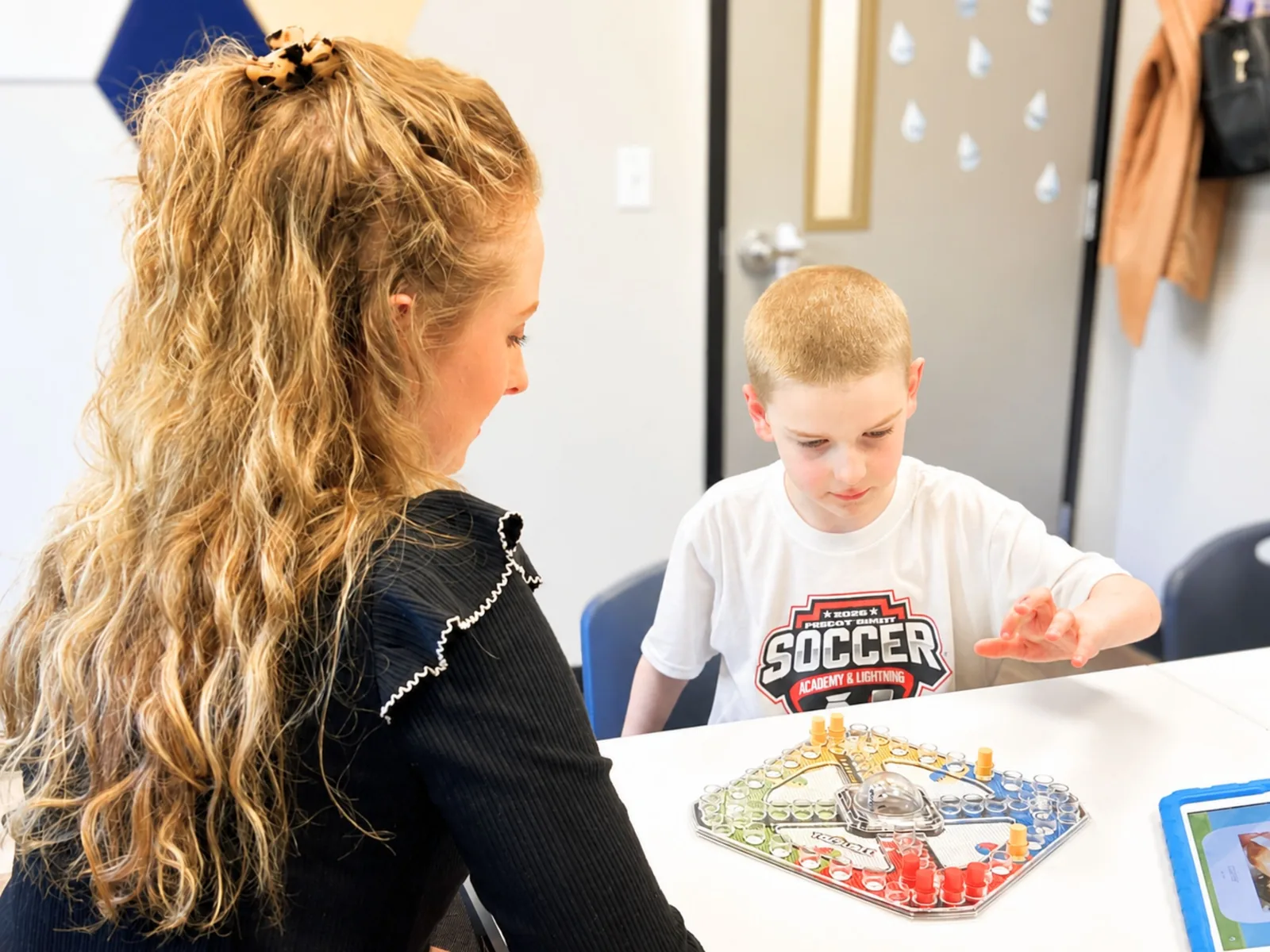
Family game night isn’t just fun, it’s one of the best ways to build vocabulary, memory, reasoning, and social communication. Here are games worth adding to your collection, organized by the skills they target.
Catchphrase (ages 8+) Targets: vocabulary, word retrieval, categorization, describing
Players describe a secret word without saying it while racing against a timer. A fast-paced, hilarious game that builds the exact skills needed for strong expressive language.
Guess Who? (ages 5–15) Targets: formulating yes/no questions, similarities and differences, turn-taking
Players ask yes/no questions to identify the other person’s secret character. Builds question formation and logical reasoning in a low-pressure format.
Headbanz (ages 8–12) Targets: formulating questions, vocabulary, categorization, describing
Each player wears a card on their forehead without seeing it and asks questions to figure out what it is. Highly motivating for kids who resist more structured practice.
Taboo (ages 13+) Targets: vocabulary, word retrieval, synonyms, describing
Players describe a word without using a list of “taboo” related words. Excellent for older children and teens building expressive language and flexible thinking.
Apples to Apples Junior (ages 9+) Targets: vocabulary, categorization, perspective-taking, humor
Players choose cards from their hand that best match a descriptor card chosen by the judge. Sparks a great discussion and teaches children that language can be used creatively and persuasively.
Pictionary (ages 8+) Targets: vocabulary, visual-spatial skills, turn-taking
Drawing to communicate a word or phrase builds vocabulary and the ability to convey meaning without words, a surprisingly valuable skill.
Boggle Junior / Scrabble Junior (ages 5–8) Targets: letter-sound knowledge, spelling, vocabulary
A gentler introduction to word-building games that reinforces early literacy skills through play.
Summer Learning Games
Summer is a natural time for language-rich activities, but it can also be when learning slides without the structure of school. These activities keep skills sharp without feeling like homework.
Life-Sized Board Game. Create a path through your backyard or driveway using colored sheets of cardstock or sidewalk chalk squares. Roll a die to determine how many spaces to move. At each square, complete a task, read a sight word, spell a vocabulary word, answer a trivia question, or follow a direction. Customize the task cards to target whatever your child is working on.
Math Ball. Stand or sit in a circle and pass a ball while counting by 2s, 5s, or 10s. When a player reaches a multiple of a target number (e.g., every multiple of 3), they say “beep” instead of the number. Miss it, and the count starts over. Simple, active, and surprisingly effective for building number fluency.
Cloud Story Writing. Find a comfortable spot outside and watch the clouds. Identify shapes and build a story together around what you see: “That one looks like a pirate ship, where is it going? What’s inside?” Have your child narrate the story out loud, then write it down when you go back inside.
Frequently Asked Questions
How do I get my child interested in playing these games? Start with whatever they already find fun and layer in language naturally. A child who loves cars will engage more in a game that involves cars. A child who loves animals will stay longer in a game with animal themes. Let their interests lead, and the language practice follows.
Can these games replace formal speech therapy? These games are excellent supplements to therapy, they create additional repetitions and opportunities to use language in natural, low-pressure contexts. For children with identified speech or language delays, they work best alongside professional support rather than instead of it.
My child gets competitive and upset when they lose. Any tips? Use these moments as opportunities to practice emotional regulation and sportsmanship. Acknowledge the feeling: “It’s frustrating to lose, that’s normal.” Then model coping: “I feel that way too sometimes. Let’s take a breath and try again.” If losing consistently causes major distress, it’s worth discussing with your child’s therapist.
Are there apps or digital versions of these games? Yes, many of these games have app versions, and there are excellent speech and language apps available as well. That said, in-person play with a real conversation partner produces richer language outcomes than solo digital play. Use apps as a supplement, not a replacement.
How ETLC Can Help
If you’re looking for more ways to support your child’s speech and language development, or wondering whether your child might benefit from an evaluation, our team is here to help.
Learn more about our Speech-Language & Social Skills services or schedule a free consultation to talk with a member of our team.
You may also find these pages helpful:
About the Author
Sonia Strueby, M.A., CCC-SLP, is the founder of Enrichment Therapy & Learning Center. With over 25 years of experience as a speech-language pathologist, Sonia has dedicated her career to helping children overcome complex communication and academic challenges. She has advanced training and a special focus on treating dyslexia and childhood apraxia of speech, and she is passionate about providing families with a clear path to success.




0 Comments