


Originally Published: March 29, 2021 | Updated: September 1, 2026
Has your child ever asked questions like these?
- “Why do I need to learn how to spell words correctly? Won’t spell check do that for me?”
- “Is there hope that I will learn to spell words correctly?”
- “If people can figure out what I am trying to say in my writing, why do I need to spell every word correctly?”
We’ll answer these questions, then share some fun ways to practice spelling words.
First, spell checkers are a great tool for improving the accuracy of written work, but they aren’t foolproof. A spell-checker might not catch common mistakes, such as “their” in place of “they’re,” or “its” in place of “it’s.”
No program or plan can guarantee your child will never make a spelling mistake. However, according to Reading Rockets, time spent connecting a word to a mental image or pattern can help spelling “stick” over time, so your child can spell it correctly in the future.
Finally, while people might be able to figure out what your child is writing even if every word isn’t spelled correctly, it’s still important to aim for correct spelling. We want written communication to be easy to read and understand. If a reader has to wade through misspelled words, some of the meaning may get lost along the way.
If your child has been practicing spelling words the same way over and over, maybe it’s time to try some new methods.
6 Fun Ways to Practice Spelling Words
1. Visualize the Spelling Word
Write the word on an index card using black ink and lowercase letters. Ask your child to visualize the word, making a picture of it in their mind. Remove the word from sight and have them fingerspell it in the air, saying the letters as they write them. Ask questions about the word: What’s the first letter? What’s the third letter? What’s the last letter? Then ask them to visualize the word and spell it backward, starting with the last letter and working toward the first. Finally, have them write the word using black ink on another index card or a piece of paper, saying the letters as they write it.
2. Use the Spelling Words in a Memory Game
Choose six or seven words your child is learning to spell and write each one on two separate index cards. Arrange the cards face down in any order. Take turns choosing two cards at a time, looking for a matching pair. Each time you turn a card over, say the word, or say and spell it. Your child can even play this alone, timing themselves to see how fast they can find all the pairs.
3. Look for Smaller Words Within the Spelling Word
Finding smaller words within a word can help your child remember how to spell it, especially if they can find a way to connect it. For example, we can see the word “ear” in “hear,” so your child could remember that we hear with our ear. Similarly, we can see the word “pie” in “piece,” so they could think of a piece of pie.
4. Focus on Difficult Parts of the Word
Take the words “stationery” and “stationary.” We can remember which spelling to use by focusing on the difference between the two. “Stationery” refers to paper for writing letters, and both “paper” and “letter” have /er/ in them, just like “stationery.” “Stationary” means not moving, or staying in one spot. You can think of the word “stay,” which has an /a/ in it, just like “stationary.”
5. Write the Words in Fun Ways
Try writing words in stair-step fashion, like this:
s
sk
ska
skat
skate
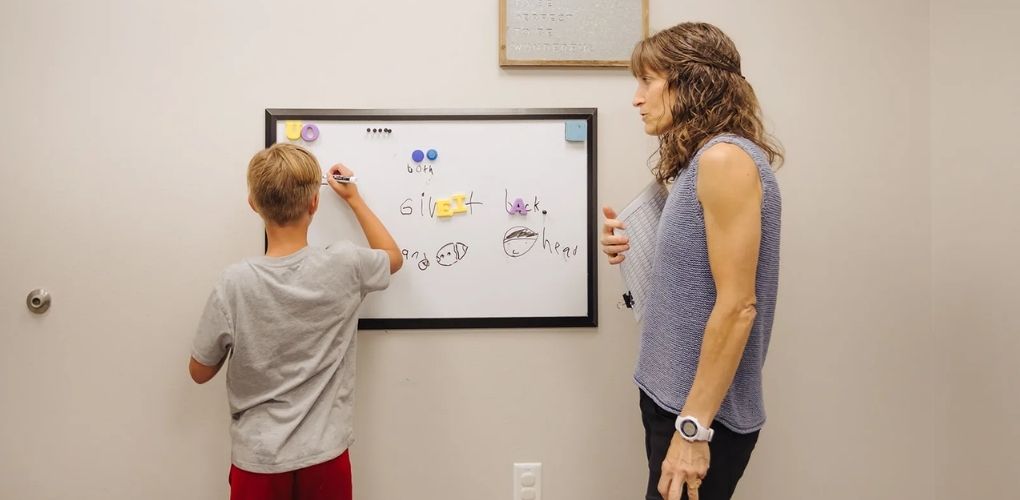
Or write the words with tall letters, wide letters, curly letters, and more.
6. Use Mnemonics to Learn a Word
If your child creates the mnemonic themselves, they’re much more likely to remember it. And it’s fine if it’s silly, as long as it’s memorable. Here’s an example for the word “rhythm”: Rhythm helps your two hips move.
We’re Here to Help
These are just a few fun ways for your child to practice spelling. If you’d like more information about how we can work with your child to improve their communication skills or academic success through our tutoring and academic support services, please feel free to reach out.

0 Comments