

Originally Published: September 27, 2023 | Updated: September 2, 2026
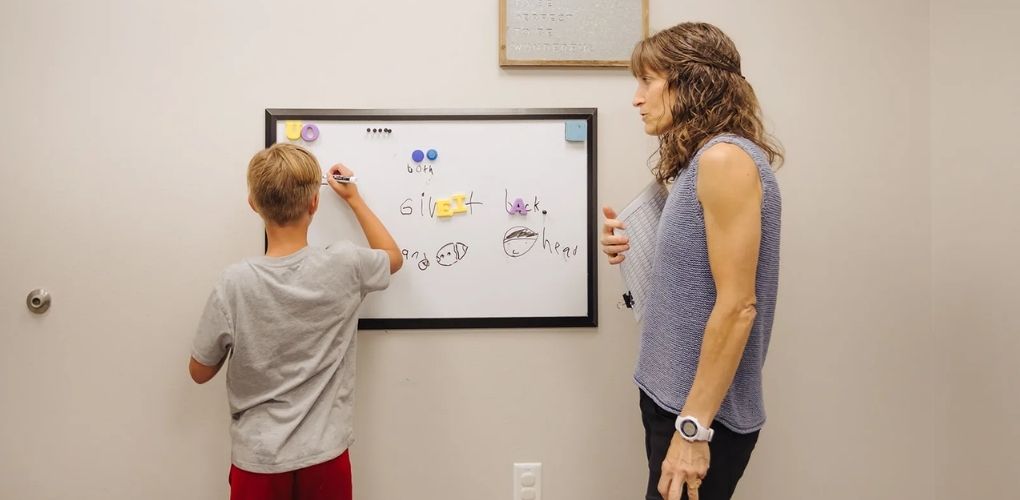
Have you ever wondered what skills it takes to complete a STEM project? We often overlook how much speech and language skills for STEM actually matter for science, technology, engineering, and math projects. We rely on sequencing and planning, vocabulary, reading, following directions, and social communication throughout. Let’s take a closer look at how we use these five skills during a typical STEM project.
Sequencing and Planning
One of the many skills we work on in speech therapy is sequencing and planning: the ability to form an idea, identify the steps required to complete it, and carry those steps out in order to reach a goal. According to Harvard’s Center on the Developing Child, this kind of planning is a core executive function skill, and it’s especially important when completing a science experiment or working through a math problem.
For kids with a language or executive functioning delay, this skill doesn’t always come easily, which can make STEM activities feel more difficult and less fun. These kids often attend speech therapy to build their sequencing and planning skills, making daily tasks and STEM experiments more accessible.
Vocabulary
Vocabulary refers to the words someone knows and uses. As we grow and develop more language skills, our vocabulary grows right along with them. Having an extensive vocabulary helps us comprehend, speak, read, and write. When working in STEM, understanding written or spoken directions is essential for carrying out different tasks.
It’s also important to communicate your thoughts clearly with others in order to collaborate or ask for help. Without an expanded vocabulary, that would be far more difficult, and much of your time would go toward looking words up rather than completing the project itself.
Reading
Reading is crucial for completing any experiment, problem, or project. Whether you’re trying something new on your own or following directions, there’s always something you need to read to complete these tasks efficiently.
So how does reading relate to speech and language? For one, a strong foundation in speech skills, and understanding how sounds work together to form words, helps when reading new words. This basic understanding lets someone sound out a word they’ve never seen before. On top of that, reading is a major part of language overall. Language shows up not just in speaking and listening, but in reading and writing too.
Following Directions
Being able to read the words that make up directions is one skill. Understanding those directions and actually following them is another. As we covered above, understanding how sounds work is an important foundation for reading new words, which matters a lot when reading directions or researching something unfamiliar.
From there, the next step is understanding what those words mean and putting them together mentally to carry out what the directions ask. Following directions is a language skill that’s extremely important, and it’s often a specific target in speech therapy for kids who struggle in this area.
Social Communication
Social communication skills let us interact with others appropriately, and we rely on them not just to make friends but to collaborate with peers or teachers on experiments and projects. Most of us know that participating in STEM is more fun and efficient when it’s done with others.
For some kids, social communication doesn’t come as naturally as it does for others. Many attend speech therapy specifically to practice these skills, and our post on social skill development covers this in more depth.
Try It Yourself!
Next time you’re completing a project, whether in physics, biology, chemistry, robotics, engineering, cooking, astronomy, or anything else, ask yourself how you’re using each of the five areas above. STEM wouldn’t be possible without speech and language.
Below is an experiment to try for yourself.
SLIME: Speech and Language In My Experiment
What You Need:
- 4 tbsp glue
- 1 tbsp Borax
- Food coloring (optional)
- 4 tbsp water
- 2 cups
- Popsicle sticks
- Measuring spoons
Directions:
- Mix water and Borax into one cup. Stir with a popsicle stick.
- Grab another cup and mix glue, a few drops of food coloring, and water into that cup. Stir with a popsicle stick.
- Slowly pour the Borax mix into the glue mix, and stir with a clean popsicle stick.
- Your slime is done when you can pick up your popsicle stick and most of the slime comes out with it.
Build Foundational Skills With ETLC
If you find that your child may need some extra support, contact us today. At Enrichment Therapy & Learning Center, we strive to provide a comfortable, supportive environment alongside high-quality therapy services that build each child’s skills. We also partner closely with parents and other caregivers to help generalize skills and strategies beyond the therapy room, including executive functioning support. If you have concerns about your child’s development, please contact us.


0 Comments