

Written by: Sonia Strueby, M.A., CCC-SLP, Founder of Enrichment Therapy & Learning Center
Originally Published: January 2017 | Updated: August 31, 2026
Does your child have a tough time switching from a fun activity to a necessary task like getting dressed or brushing teeth? Do these transitions often lead to frustration or meltdowns? If so, a first/then schedule is one of the simplest and most powerful tools you can use.
This visual strategy helps children understand expectations, manage transitions, and stay motivated to complete less-preferred tasks. This guide will walk you through exactly how to introduce and use a first/then board to create smoother routines in your home.
What Is a First/Then Schedule and Why Does It Work?
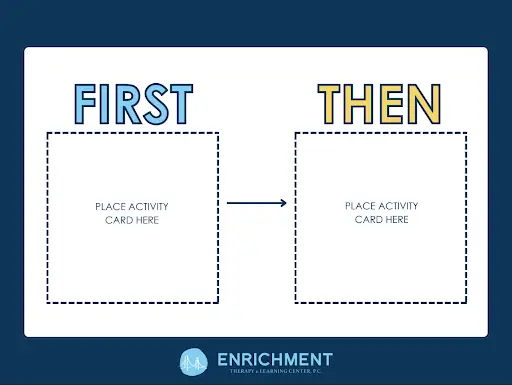
A first/then schedule (or board) is a visual tool that shows a child what they need to do now (First) and what rewarding activity will come immediately after (Then).
It works because it makes time and expectations concrete. For a child, a command like “clean up your toys” can feel overwhelming and endless. The first/then board provides a clear, visual promise that a fun activity is coming right after the task is done, which provides powerful motivation.
How to Introduce a First/Then Board: A 4-Step Guide
Step 1: Start with Two Fun Activities
Your first goal is to teach your child how the board works in a positive, low-pressure way. To do this, pair two activities your child already enjoys. This helps them build a positive association with the board itself.
Example: “First listen to music, then play with cars.”
Step 2: Narrate Every Part of the Process
Refer to the board before, during, and after the activities. This repetition is key to helping your child understand the connection between the visual and the action.
- Before: Point to the pictures and say, “First, music. Then, cars.”
- During: When the first activity is over, say, “Music is all done! Now it’s time for cars.”
- After: Celebrate the completion: “We did it! First, we listened to music, and then we played with cars.”
Step 3: Shift to a ‘Work, Then Play’ Model
Once your child understands the concept, you can start using the board for its main purpose: motivating them through a less-preferred task. The “First” slot will now be the task you need them to do, and the “Then” slot will be their reward.
Example: “First brush teeth, then play the iPad game.”
Step 4: Use Clear, Specific Visuals
The power of the board is in its visual clarity. Use pictures that your child can easily understand. For many children, taking actual photos of them doing the specific activity (e.g., a picture of their toy cars, a photo of them brushing their teeth) is the most effective approach.
You can see a video demonstration of how to use a first/then schedule in our Therapy Talk here.
Frequently Asked Questions
Where can I get a First/Then board? You can easily make one with a piece of paper and tape. We also offer a free, ready-to-use template you can download and print at home. You can get your copy here.
What if my child gets upset and just wants the “Then” activity now? This is very common at first. Stay calm and be consistent. Gently redirect them back to the board and calmly repeat, “Yes, you can play cars. First, we put on our shoes.” The key is not to give in and give them the “Then” item early, as this teaches them that the board is optional.
What age is this strategy good for? First/Then schedules are most effective for toddlers and preschoolers (roughly ages 2-5), but they can be adapted for older children with developmental delays or behavioral challenges.
Do I have to use pictures, or can I just write the words? For pre-readers and early readers, pictures are essential. For older children who read fluently, you can transition to using just written words. The most important thing is that the visual is clear and understandable to your child.
About the Author
Sonia Strueby, M.A., CCC-SLP, is the founder of Enrichment Therapy & Learning Center. With over 25 years of experience as a speech-language pathologist, Sonia has dedicated her career to helping children overcome complex communication and academic challenges. She has advanced training and a special focus on treating dyslexia and childhood apraxia of speech, and she is passionate about providing families with a clear path to success.


0 Comments