

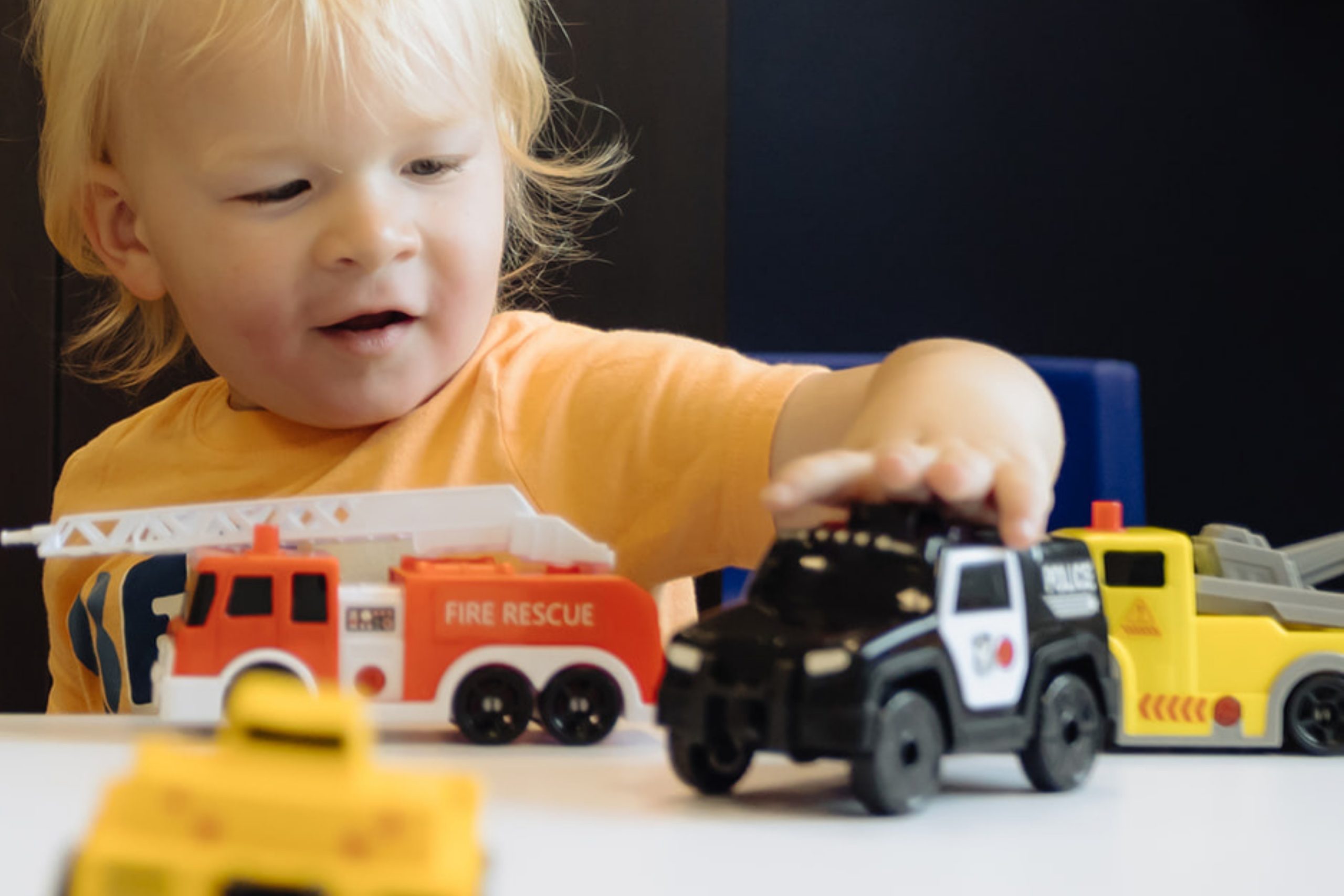
Playtime is a crucial part of your child’s development, and it is also one of the best times to work on building speech and language skills. In the unstructured setting of play, children feel like they are calling the shots. They are so busy having fun that they don’t realize they are learning at the same time. Below are five ways to build your child’s speech and language skills while they play whatever they want to play.
Parallel Talk
Parallel talk means talking about what your child is doing. If your child is rolling a car across the floor, you might say, “The car goes fast!” If they put an animal in the car, you could say, “Dinosaur in the car” or “Dinosaur is driving.” You can also narrate what you are doing. Short phrases like “Car go up” and “Put it in” teach spatial concepts along with language. This strategy helps children understand that their actions have words that go with them, and the goal is to get kids talking about what they are doing during play.
Unexpected Events
Do a little prep work by setting up the play space so that something unexpected happens. Maybe a toy is “broken” because you took out the batteries, or a favorite toy is out of reach or in a hard-to-open box or bag. These moments may lead your child to ask for help or become frustrated, and that creates a chance to teach them how to communicate in that moment. You might say, “Oh, you need help, don’t you? You can say, ‘Mommy, help!'” Emphasize the word you want your child to learn. This keeps language practice in its natural context.
Waiting
After you communicate something to your child, resist the urge to say or do something else right away. Children take longer to process language while they are learning it, and a steady stream of questions can overwhelm them. Wait time gives your child a chance to respond in their own way. In the example above, you would not fix the “broken” toy right after modeling how to ask for help. Wait about 30 seconds and see what your child does. They may surprise you.
Following Your Child’s Lead
This strategy is about keeping your child engaged and interested. Let your child choose the activity and follow along. A child who is interested and having fun is more likely to connect with the language you are modeling than one playing a game they did not pick. If your child has a hard time choosing, offer a choice between two or three activities.
Limit Questions
This one is a “what not to do” during play, and it is tricky to stick to, even for speech-language pathologists. A question demands a response, which can seem like a perfect way to get a child talking. It also puts pressure on the child, and a child who is unsure what to say may talk less. Instead, provide the answer yourself. Rather than asking, “What does a cow say?” say, “A cow says moo!” Then use the waiting strategy and see how your child responds.
Bonus: Take Turns
Try to build in turn-taking whenever you play. Taking turns during games helps children learn to take turns while communicating, too. It also supports sharing, patience, and self-regulation, which all matter as speech and language skills continue to develop.
What to Expect
These strategies fit naturally into play because your child doesn’t realize they are learning. Fun, memorable experiences can help children build connections more easily than structured tasks alone. Keep in mind that you may not see changes right away. If you model putting a noun and a verb together through parallel talk, for example, don’t expect your child to start doing it that same day. These skills take time and patience, and what you model today supports the language your child uses in the future.
Frequently Asked Questions
What if my child doesn’t respond when I wait?
That is common, especially early on. Keep modeling short phrases, give your child a little more time, and try again during another play session. Responses often come gradually.
How long should we play this way each day?
There is no required amount. A few minutes of child led play is a good place to start, and you can use the same strategies during everyday routines like bath time or car rides.
When should I talk to a speech-language pathologist?
If your child seems behind on speech or language milestones, is frustrated by communication, or isn’t making progress despite consistent practice, a speech-language pathologist can help. Our team is happy to talk it through with you.
How ETLC Can Help
Play is where language grows, and you are already giving your child the best setting for it. If you have questions about your child’s speech and language development, or you want guidance on using these strategies at home, our team is here to help. Enrichment Therapy & Learning Center has locations in Johnston and North Liberty, IA, with virtual services also available.
Learn more about speech-language therapy at ETLC or schedule a free consultation to talk with a member of our team.
You may also find these pages helpful:
- Early Intervention at ETLC
- How to Build Your Child’s Language Skills Through Everyday Play
- Toddler Talk: 7 Tips to Increase Language Development
About the Author
Sonia Strueby, M.A., CCC-SLP, is the founder of Enrichment Therapy & Learning Center. With over 25 years of experience as a speech-language pathologist, Sonia has dedicated her career to helping children overcome complex communication and academic challenges. She has advanced training and a special focus on treating dyslexia and childhood apraxia of speech, and she is passionate about providing families with a clear path to success.

0 Comments