

If your child is learning to read and struggling, there's a good chance phonological awareness is part of the picture. It's one of the most important — and most misunderstood — pre-reading skills there is.
Phonological awareness is the ability to hear, identify, and manipulate the sounds in spoken language. It has nothing to do with letters or print — it's entirely about sound. And it turns out to be one of the strongest predictors of reading success we know of. Children who develop strong phonological awareness skills learn to read more easily, spell more accurately, and decode unfamiliar words with confidence.
This guide explains what phonological awareness is, how it develops, and what you can do at home to support it at every stage.
What Is Phonological Awareness?
Phonological awareness is a broad term that covers a range of sound-based skills, from the simplest to the most complex. These include:
- Recognizing and producing rhymes (cat, hat, mat)
- Identifying beginning, middle, and ending sounds in words
- Segmenting words into syllables or individual sounds (cat = /k/ /æ/ /t/)
- Blending sounds or syllables back together to form words
- Deleting sounds or syllables from words (say "slip" without the /l/ — "sip")
- Adding sounds to create new words (say "nail" with an /s/ at the beginning — "snail")
- Manipulating sounds to make entirely new words (replace the /t/ in "tuck" with /d/ — "duck")
An important distinction: phonological awareness is about sound, not spelling. The word "gate" has four letters but only three sounds — /g/ /ay/ /t/. When we work on phonological awareness, we think with our ears, not our eyes.
Why Is Phonological Awareness So Important?
Phonological awareness is the foundation of decoding — the ability to sound out written words. Without it, reading becomes a guessing game.
Research has consistently shown that phonological awareness is one of the best predictors of early reading success. It is also the primary area of breakdown in dyslexia. Children with dyslexia typically have strong intelligence and vocabulary but struggle specifically with the sound structure of words — which is why structured, explicit phonological awareness instruction is a cornerstone of effective dyslexia intervention.
The earlier phonological awareness skills are developed, the stronger the foundation for reading, spelling, and writing.
The Phonological Awareness Hierarchy: What Develops When
Phonological awareness skills build on each other in a predictable sequence — from simpler to more complex. Here's what most children develop and when:
This hierarchy matters because it tells us where to start. If a child is struggling with phoneme blending, we don't jump straight to manipulation — we make sure the foundational skills below it are solid first.
How to Build Phonological Awareness at Home
Start With Rhyming
Rhyming is the earliest phonological awareness skill to develop, and one of the most enjoyable to practice. Most children master rhyme recognition by age five — and building it in early lays important groundwork for everything that follows.
Read rhyming books together. As you read, emphasize the rhyming words. Pause before the rhyming word and let your child fill it in. Dr. Seuss books are classics for this, as are Bear Wants More by Karma Wilson, Chicka Chicka Boom Boom by Bill Martin Jr., and Snowmen at Night by Caralyn Buehner.
Sing rhyming songs. Songs like Wheels on the Bus, Itsy Bitsy Spider, and traditional nursery rhymes build rhyme awareness through repetition and rhythm.
Play silly rhyme chains. Take a word and see how many rhyming words — real or made up — you can generate together: "toy, boy, roy, poy, noy." Using nonsense words is perfectly fine and actually reinforces that rhyming is about sound, not meaning.
Fill in the blank. Say a sentence and leave the last word out: "I see a dog on a ___." Your child supplies a rhyming word. Silliness is encouraged.
Practice Segmenting
Segmenting is the ability to break language apart — sentences into words, words into syllables, syllables into individual sounds.
Start at the sentence level. Have your child count the words in a spoken sentence, touching a block or tapping a finger for each word. Then try writing a simple sentence, cutting it apart word by word, and putting it back together.
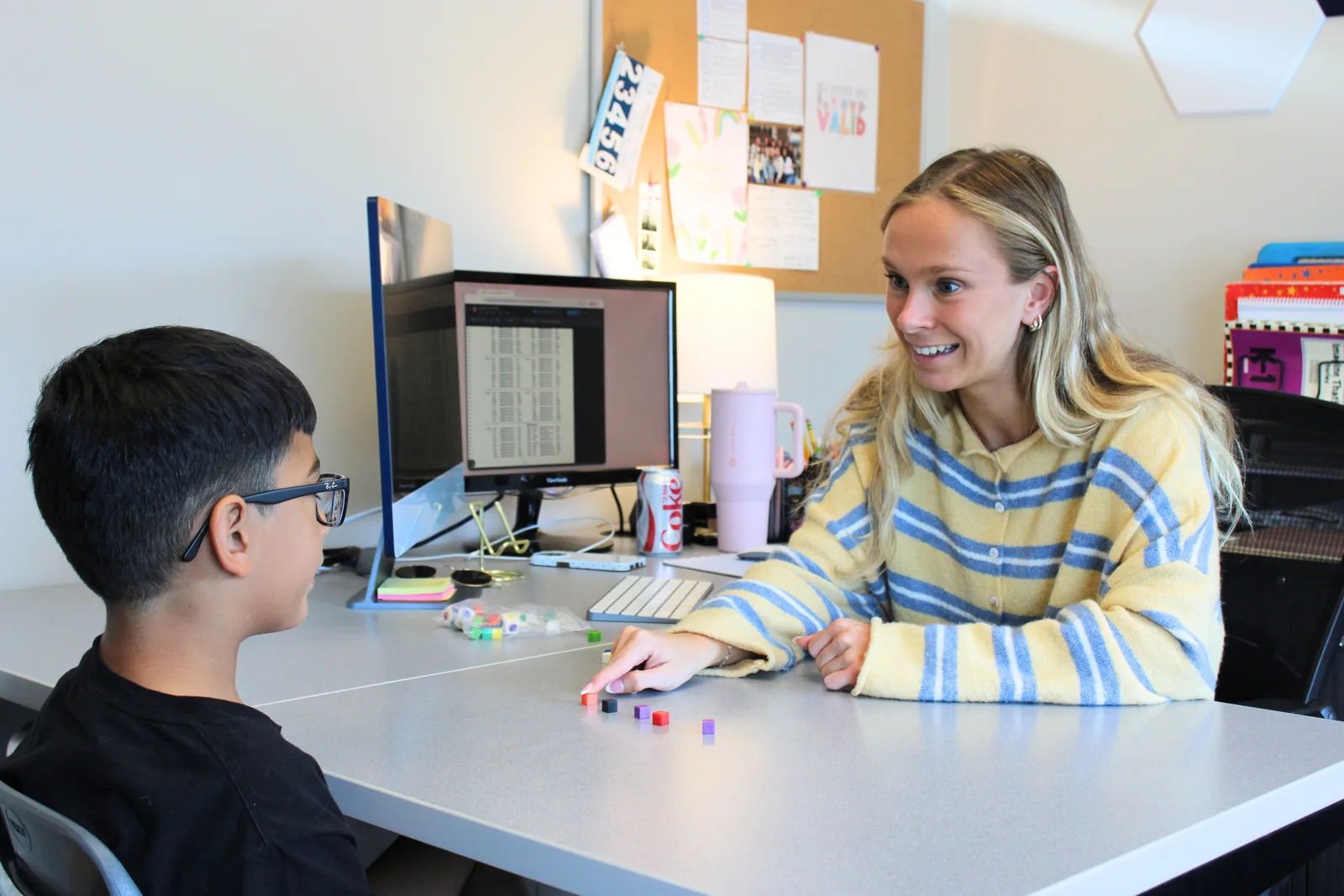
Move to compound words. Words like cupcake and rainbow are easy to segment because each part is a real word on its own. Use blocks — one for each part — and physically separate them as you say each piece.
Then tackle syllables. Clap, tap, or snap the syllables in words. Names are a great place to start: "Jai-mi" (2 claps), "Max" (1 clap), "A-lex-an-der" (4 claps).
Finally, work on individual sounds (phonemes). "Cat" has three sounds: /k/ /æ/ /t/. Use small objects or coins — one for each sound — and slide them forward as you say each one.
Practice Blending
Blending is the reverse of segmenting — pulling sounds or syllables back together to form a word. It's the skill children use when they decode written words by sounding them out.
Start with compound words. Say "rain" and "bow" separately, then slide two pictures together as you blend them into "rainbow."
Move to syllables. Cut words into syllable pieces with puzzle-shaped edges so they fit together — a visual that makes the concept click for many children.
Then blend phonemes. Say sounds slowly and ask your child to blend them: "/p/… /i/… /g/ — what's the word?" Start with two-sound words and gradually build to longer ones.
Why Nonsense Words Matter
One highly effective — and often puzzling — tool in phonological awareness practice is nonsense words: made-up words like pak, cit, pech, or tigup.
Nonsense words follow real phonics rules, but because they have no meaning, a child can't guess them based on context. To read a nonsense word correctly, a child must rely entirely on their sound knowledge — which is exactly the skill we're building.
Nonsense words are especially helpful for children who tend to guess at unfamiliar words using only the first few letters. If everything on the list is a nonsense word, there's nothing to guess — just sounds to decode.
Try this: give your child a nonsense word and challenge them to add a sound to turn it into a real word. "Oop" + /h/ at the beginning = "hoop!" This kind of sound play is both effective and surprisingly fun.
Frequently Asked Questions
How do I know if my child's phonological awareness is on track? Use the hierarchy table above as a general reference. If your child is significantly behind the typical milestones for their grade — especially in segmenting or blending — it's worth discussing with a speech-language pathologist. Early support makes a significant difference.
My child can read words but can't do phonological awareness tasks. Is that possible? Yes. Some children memorize words visually without building the underlying sound skills. This often works in early grades but creates significant difficulty as words get longer and less familiar. Strengthening phonological awareness — even after a child is reading — is worth the effort.
Is phonological awareness the same as phonics? No, though they're closely related. Phonological awareness is about sounds in spoken language. Phonics connects those sounds to letters and print. Phonological awareness typically develops first and supports phonics instruction.
My child's teacher mentioned phonemic awareness. Is that different from phonological awareness? Phonemic awareness is a subset of phonological awareness — specifically the ability to work with individual sounds (phonemes) in words. Phonological awareness is the broader term that includes rhyming, syllables, and all other sound-based skills.
How long does it take to build phonological awareness skills? With consistent, targeted practice, many children make meaningful progress within a few weeks to months. The earlier the intervention begins, the faster and more lasting the results.
How ETLC Can Help
If your child is struggling with reading, spelling, or the foundational sound skills that support them, our team can help. We provide comprehensive evaluations and individualized therapy targeting phonological awareness, phonics, and structured literacy.
Learn more about our Speech-Language & Social Skills services orschedule a free consultation to talk with a member of our team.
You may also find these pages helpful:
About the Author
Sonia Strueby, M.A., CCC-SLP, is the founder of Enrichment Therapy & Learning Center. With over 25 years of experience as a speech-language pathologist, Sonia has dedicated her career to helping children overcome complex communication and academic challenges. She has advanced training and a special focus on treating dyslexia and childhood apraxia of speech, and she is passionate about providing families with a clear path to success.

0 Comments