

If your child is learning to read and struggling, there’s a good chance phonological awareness is part of the picture. It’s one of the most important pre-reading skills, and one of the most misunderstood.
Phonological awareness is the ability to hear, identify, and work with the sounds in spoken language. It has nothing to do with letters or print, because it’s entirely about sound. It’s also among the strongest predictors of reading success we know of. Children who build strong phonological awareness skills tend to learn to read more easily, spell more accurately, and decode unfamiliar words with more confidence.
This guide explains what phonological awareness is, how it develops, and what you can do at home to support it at every stage.
What Is Phonological Awareness?
Phonological awareness is a broad term that covers a range of sound-based skills, from the simplest to the most complex. These include:
- Rhyming: recognizing and producing words that rhyme, like cat, hat, and mat
- Identifying sounds: finding the beginning, middle, and ending sounds in words
- Segmenting: breaking words into syllables or individual sounds, like cat = /k/ /a/ /t/
- Blending: putting sounds or syllables back together to form words
- Deleting: removing a sound or syllable, like “say slip without the /l/” to get “sip”
- Adding: adding a sound to make a new word, like “say nail with an /s/ at the beginning” to get “snail”
- Manipulating: swapping sounds to make a new word, like replacing the /t/ in “tuck” with /d/ to get “duck”
An important point is that phonological awareness is about sound, not spelling. The word “gate” has four letters but only three sounds: /g/ /ay/ /t/. When we work on phonological awareness, we think with our ears, not our eyes.
Why Is Phonological Awareness So Important?
Phonological awareness is the foundation of decoding, which is the ability to sound out written words. Without it, reading can become a guessing game.
It also matters for dyslexia. According to the International Dyslexia Association, dyslexia often involves difficulty with the sound structure of language. Children with dyslexia often have strong thinking skills and vocabulary but struggle specifically with the sounds in words, which is why structured, explicit phonological awareness instruction is a key part of dyslexia intervention. The earlier these skills are built, the stronger the base for reading, spelling, and writing.
The Phonological Awareness Hierarchy: What Develops When
Phonological awareness skills build on each other in a predictable order, from simpler to more complex. Children typically start with rhyming and sentence and syllable skills, and then move to working with individual sounds.
This order matters because it tells us where to start. If a child is struggling with blending sounds, we don’t jump straight to manipulation. Instead, we make sure the skills below it are solid first. For the full list, see our post on the phonological awareness hierarchy, or see phonological awareness by grade level for when each skill is typically mastered.
How to Build Phonological Awareness at Home
Start With Rhyming
Rhyming is the earliest phonological awareness skill to develop, and it’s one of the most enjoyable to practice. Most children can recognize rhymes by around age five, and building the skill early lays groundwork for what follows. Words that rhyme sound the same at the end, and spelling doesn’t matter. For example, “tall” and “doll” are spelled differently, but they rhyme.
- Read rhyming books: Emphasize the rhyming words as you read, and pause before the rhyming word so your child can fill it in. Dr. Seuss books are classics for this, as are Bear Wants More by Karma Wilson, Chicka Chicka Boom Boom by Bill Martin Jr., and Snowmen at Night by Caralyn Buehner.
- Sing rhyming songs: Songs like “Wheels on the Bus,” “Itsy Bitsy Spider,” and traditional nursery rhymes build rhyme awareness through repetition and rhythm.
- Play silly rhyme chains: Take a word and see how many rhyming words, real or made up, you can say together, like “toy, boy, roy, poy, noy.” Made-up words are fine, because rhyming is about sound, not meaning.
- Fill in the blank: Say a sentence and leave out the last word, like “I see a dog on a ___.” Your child supplies a rhyming word.
- Pick the rhyme: Say three words, like “bell, box, fell,” and ask your child which two rhyme.
- Try a word family game: Word families are made of rhymes, like pan, can, tan, ran, and fan. Play Dough to Plato shows how to make a word family rhyme wheel.
Practice Segmenting
Segmenting is the ability to break language apart, such as sentences into words, words into syllables, and syllables into individual sounds.
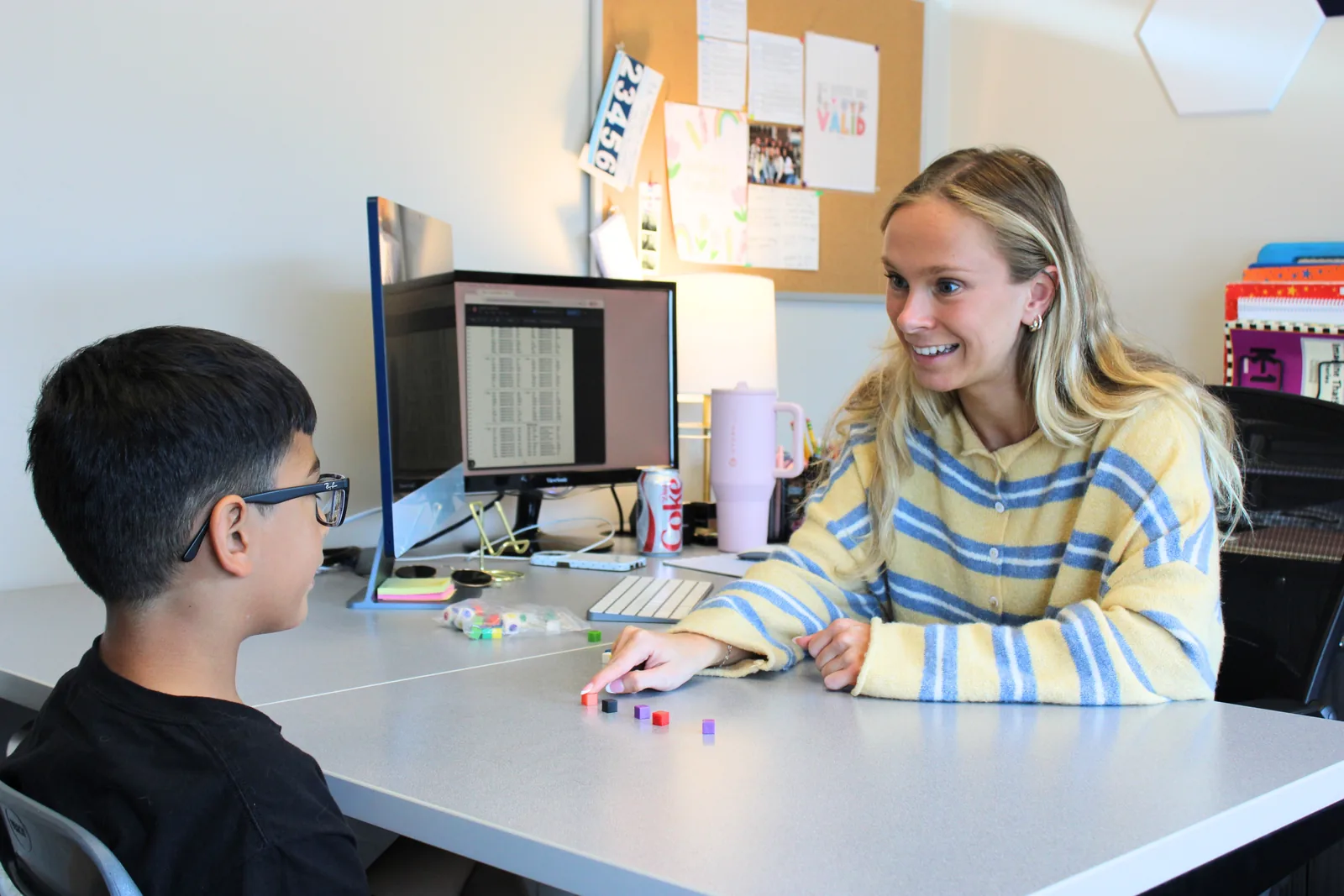
- Start with sentences: Have your child count the words in a spoken sentence, touching a block or tapping a finger for each one. You can also write a simple sentence, cut it apart word by word, and put it back together.
- Move to compound words: Words like cupcake and rainbow are easy to segment because each part is a word on its own. Use one block for each part and separate them as you say each piece.
- Then try syllables: Clap, tap, or snap the syllables in words. Names are a good place to start, like “Max” (1 clap) or “Jai-mi” (2 claps).
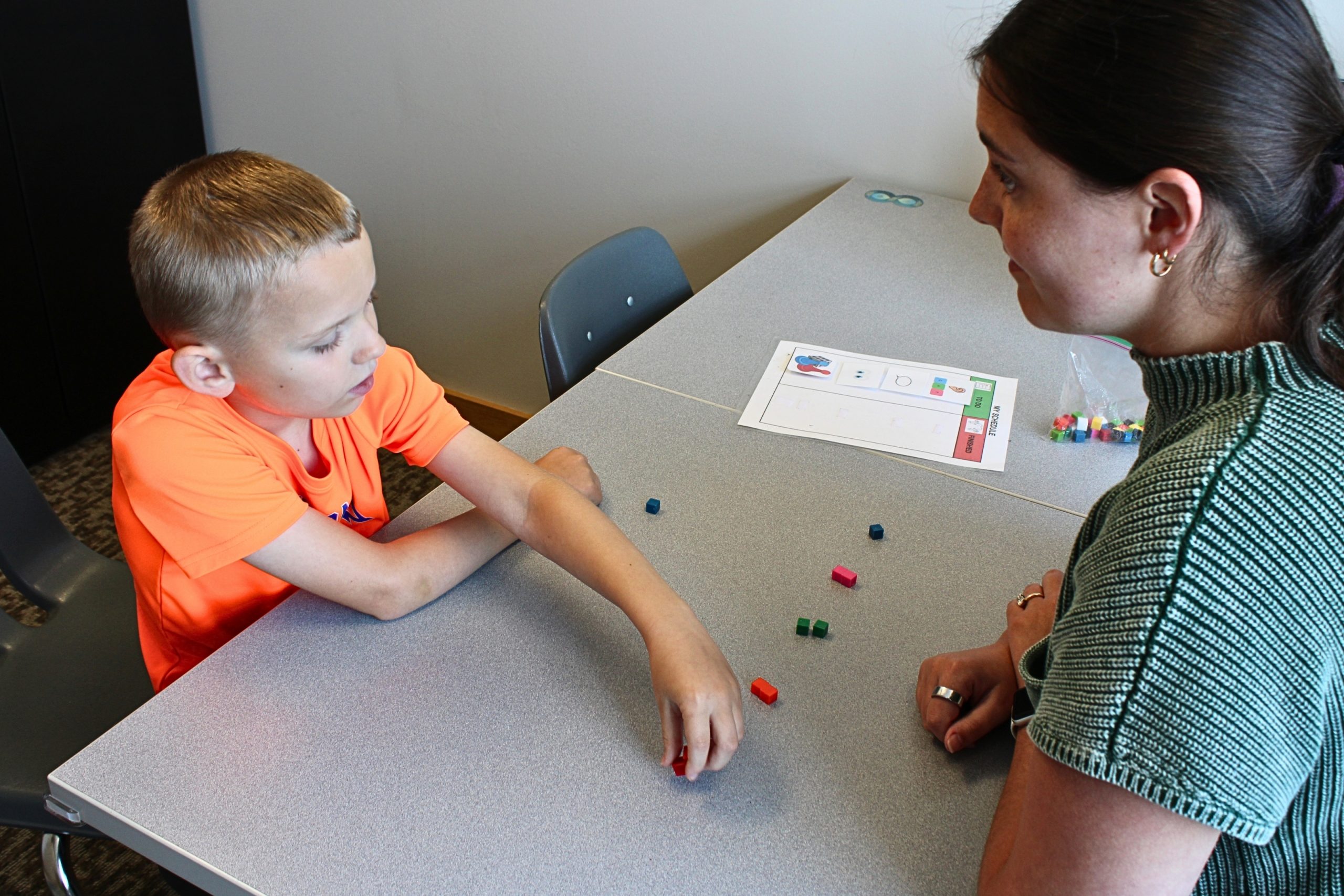
- Finally, work on individual sounds: “Cat” has three sounds: /k/ /a/ /t/. Use small objects or coins, one for each sound, and slide them forward as you say each one. Other examples are lake (/l/ /ay/ /k/) and tiger (/t/ /i/ /g/ /er/).
- Use your body: For a three sound word like “cat,” touch your head for the first sound, your hips for the second, and your toes for the third.
Practice Blending
Blending is the reverse of segmenting. Your child pulls sounds or syllables back together to form a word, which is the skill they use to sound out written words.
- Start with compound words: Say “rain” and “bow” separately, then slide two pictures together as you blend them into “rainbow.”
- Move to syllables: Write a word on paper and cut it into syllable pieces with puzzle-shaped edges. For “monster,” one piece says “mon” and the other says “ster.” In a group, whisper one syllable to each child, then have them say their parts in order, slowly at first and then faster, until they make a word.
- Then blend sounds: Say sounds slowly and ask your child to blend them, like “/p/ /i/ /g/. What’s the word?” Start with short pauses between the sounds, and make the pauses longer as your child gets more confident.
- Use your arm: For a word like “dog,” touch your shoulder for the first sound, your elbow for the second, and your hand for the third. Then slide your hand quickly from your shoulder to your hand while you blend the sounds into a word.
Why Nonsense Words Matter
Made-up words, like pak, cit, pech, or tigup, can be a useful tool in phonological awareness practice. They follow real phonics rules, but because they have no meaning, a child can’t guess them from context. To read one correctly, a child has to rely on their sound knowledge, which is exactly the skill we’re building.
They can help children who tend to guess at unfamiliar words from the first few letters. If every item on the list is a nonsense word, there is nothing to guess, only sounds to decode. You can also give your child a nonsense word and ask them to add a sound to make it a real word. For example, “oop” plus /h/ at the beginning makes “hoop!” To learn more, see our post on reading nonsense words.
Frequently Asked Questions
How do I know if my child’s phonological awareness is on track?
Use our grade level chart as a general guide. If your child seems behind, especially in segmenting or blending, it’s worth talking with a speech-language pathologist. Early support can make a real difference.
My child can read words but can’t do phonological awareness tasks. Is that possible?
Yes. Some children memorize words by sight without building the sound skills underneath. This can work in the early grades, but it often gets harder as words get longer and less familiar. Strengthening phonological awareness is worth the effort, even after a child is reading.
Is phonological awareness the same as phonics?
No, though they are closely related. Phonological awareness is about the sounds in spoken language. Phonics connects those sounds to letters and print. Phonological awareness usually develops first and supports phonics instruction.
My child’s teacher mentioned phonemic awareness. Is that different?
Phonemic awareness is one part of phonological awareness. It is the ability to work with individual sounds, called phonemes, in words. Phonological awareness is the broader term that also includes rhyming, syllables, and other sound-based skills.
How long does it take to build phonological awareness skills?
Every child is different. With regular, targeted practice, many children make progress over weeks to months, and starting earlier can help.
How ETLC Can Help
If your child is struggling with reading, spelling, or the sound skills that support them, our team can help. We provide evaluations and individualized therapy that target phonological awareness, phonics, and structured literacy. Enrichment Therapy & Learning Center has locations in Johnston and North Liberty, IA, with virtual services also available.
Learn more about dyslexia therapy at ETLC or schedule a free consultation to talk with a member of our team.
You may also find these pages helpful:
- Phonological Awareness Hierarchy: 12 Key Steps
- Phonological Awareness by Grade Level: A Chart
- Tutoring and Academic Support
About the Author
Sonia Strueby, M.A., CCC-SLP, is the founder of Enrichment Therapy & Learning Center. With over 25 years of experience as a speech-language pathologist, Sonia has dedicated her career to helping children overcome complex communication and academic challenges. She has advanced training and a special focus on treating dyslexia and childhood apraxia of speech, and she is passionate about providing families with a clear path to success.

0 Comments