

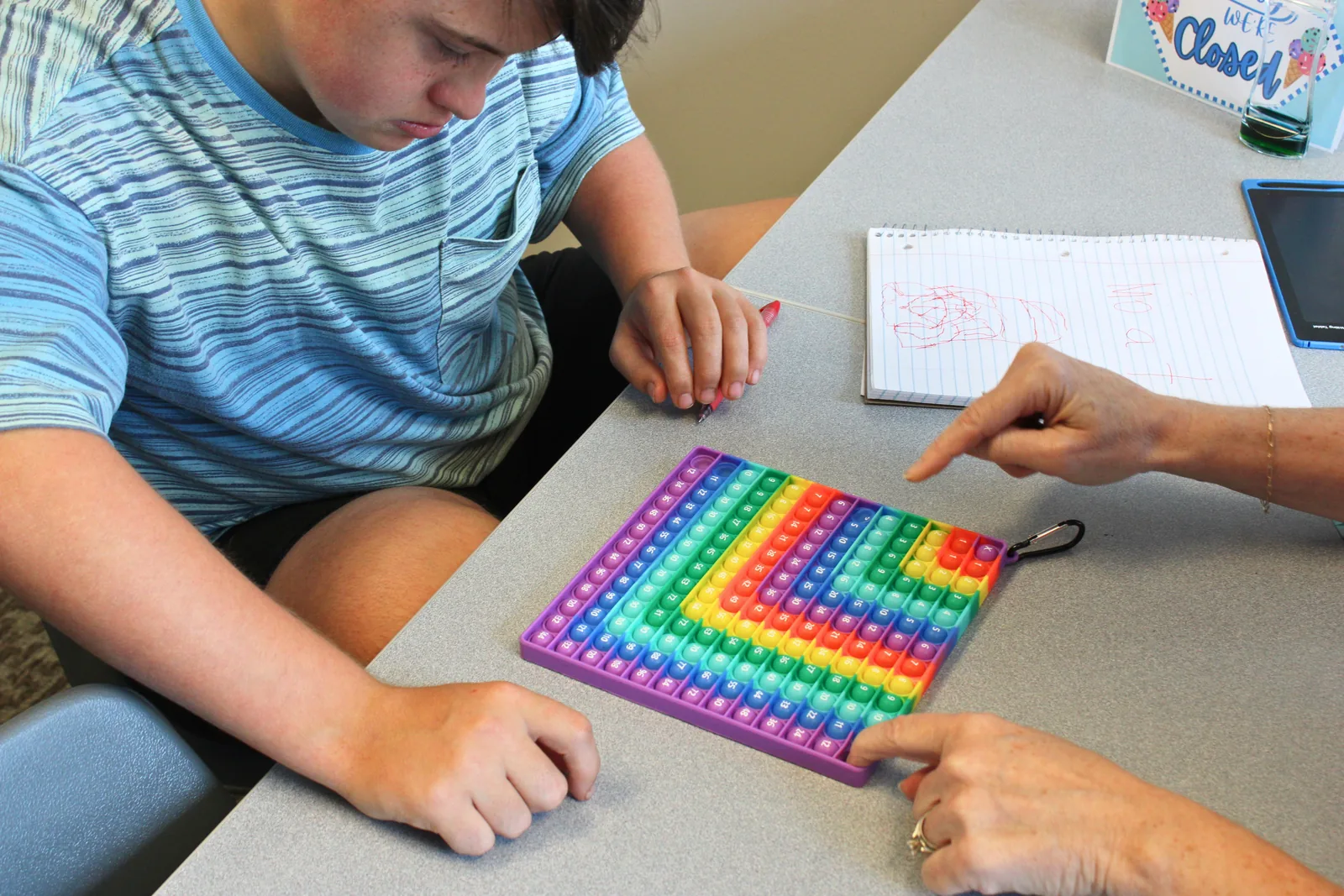
Math doesn't have to be a battle. For many children, the struggle with math isn't about ability — it's about anxiety, missing foundational skills, or never having had the right tools to make numbers feel meaningful.
Whether your child is working on counting, number recognition, math facts, or more complex concepts like place value or money, there are simple, engaging ways to build those skills at home — without worksheets, drills, or stress.
This guide covers early number sense, hands-on math activities, how to make math vocabulary stick, and strategies for tackling math anxiety.
Why Math Skills Start Early
Strong math skills begin long before a child encounters a textbook. Early number sense — understanding what numbers mean and how they relate to each other — is built through play, real-world experience, and hands-on exploration.
Children who develop solid early number sense find later math concepts easier to grasp because they have a concrete foundation to build on. The activities in this guide work best when they feel like play, not practice.
Building Early Number Skills
Number Recognition
Before a child can work with numbers, they need to recognize them reliably. Here are three activities that build number recognition in a hands-on way:
Number Wheel. Create a circle cutout with groups of objects arranged around the edge (stars, dots, stickers). Your child counts the objects in each group and clips or places the matching numeral next to it. Simple, visual, and self-checking.
Counting Tray. Use a muffin tin, small number cards, and a collection of small objects — buttons, beans, coins. Place a number card in each cup and have your child count out the corresponding number of objects into each section. When finished, have them count back to check their work.
Number Scavenger Hunt. Write a target number on slips of paper and hide them around the house. Your child goes on a hunt for that number, then counts out that many objects to match it. Vary the number each time.
One-to-One Correspondence
One-to-one correspondence is the understanding that each number represents a physical quantity — not just a word to say in a sequence. It's a foundational concept that many children need explicit practice with.
Counting with Beads. Cut pipe cleaners in half and wrap a piece of masking tape around one end of each. Write a single-digit number on the tape. Your child traces the number with their finger, says it aloud, then strings that many beads onto the pipe cleaner — one bead per count. When finished, they count the beads back to check their work.
This activity builds one-to-one correspondence, fine motor skills, and number recognition simultaneously — and children love choosing their bead colors.
Count Everything. Make a habit of counting real objects throughout the day: stairs, crackers, windows, shoes. The more varied the contexts, the stronger the concept becomes.
Place Value
Place value — understanding that the position of a digit changes its value — is one of the most important early math concepts and one of the trickiest to teach abstractly.
Flip It Activity. Cut out single-digit number cards. Choose two digits and place them side by side. "What number did we make? Four and five — forty-five." Then flip them. "Now what is it? Fifty-four." Discuss how the same two digits make completely different numbers depending on their position. Once two-digit numbers feel comfortable, move to three- and four-digit numbers.
Making Math Vocabulary Stick
One of the most overlooked reasons children struggle with math is math vocabulary. A child who doesn't know what factor, product, sum, or quotient means can't solve a word problem — even if they understand the underlying math operation.
The most effective way to make math vocabulary memorable is through visualization — creating a mental image that connects the word to its meaning.
Here's an example: the word factor sounds like factory. What do factories do? They put parts together to make a product. What are factors? They are parts that multiply together to make a larger number. Draw a factory putting two numbers together as "parts" and producing the "product" on the other end. That image sticks in a way that a definition alone never does.
Try this approach with your child for any math vocabulary word that isn't clicking:
- Say the word out loud and think about what it sounds like
- Find a connection — something familiar that sounds similar or works the same way
- Draw it, act it out, or describe it in their own words
- Apply it to a math problem using the image as an anchor
Another approach: use something your child loves. If they love gummy bears and are working on addition, have them imagine holding 3 red gummy bears and then picking up 2 yellow ones. "How many gummy bears do you have now?" The more personal and vivid the image, the better it sticks.
Practicing Money Skills
Money math is one of the most practical and motivating math applications for children — and it's easy to practice at home.
Set Up a Home Store. Collect empty food boxes, cans, and cartons. Label each item with a price using a marker or sticky label. Give your child play money and task cards like:
- "Buy 3 items. What is the total cost?"
- "You have $10. What can you buy? How much change will you get?"
- "Which is cheaper — the cereal or the crackers? By how much?"
Start with simple purchases and whole dollar amounts. Gradually introduce coins, change-making, and comparison shopping as skills grow.
Real-World Practice. Once your child is comfortable with the home store, give them real responsibility at the grocery store or a small shop. Let them hand over the money, receive change, and check whether they got the right amount back. Real transactions are far more motivating than any worksheet.
Money skills build number sense, mental math, and real-world problem-solving all at once — and children feel a genuine sense of competence when they master them.
Addressing Math Anxiety
Math anxiety is more common than most people realize — and it can affect children as young as first or second grade. Research shows that anxiety about math doesn't just reflect poor performance; it can actually cause it by interfering with working memory and the ability to think clearly during math tasks.
The adults around a child have enormous influence over how that child feels about math. A few things that help:
Model a growth mindset around math. If you say things like "I've never been good at math either" or "Math is just hard for some people," children internalize those beliefs. Instead, use language that frames math as something that improves with effort:
- "Every time you practice, you get closer to your math goals."
- "I can see you working really hard on that. That's what makes the difference."
- "Mistakes in math are how your brain learns — they're actually useful."
Separate effort from outcome. Praise the process, not the product. "I love how you kept trying even when that problem was tricky" is more powerful than "You got it right." Children who are praised for effort develop more resilience than those praised only for correct answers.
Make math feel safe. Children who are afraid of being wrong stop trying. Create an environment where getting stuck is normal, mistakes are expected, and asking for help is encouraged. The more relaxed the math environment, the more a child's actual ability can show up.
Math Facts: The Visualization Strategy
For math fact fluency specifically, the visualization strategy we use at ETLC is one of the most effective tools available. Rather than drilling facts until they're memorized through sheer repetition, this approach helps children create a mental "snapshot" of each fact that can be retrieved quickly and accurately.
The full step-by-step guide is covered in our companion blog, How to Help Your Child Practice Math Facts at Home, which walks through the technique using a concrete example.
Frequently Asked Questions
When should my child know their math facts? Most children are expected to know addition and subtraction facts by the end of 2nd grade and multiplication and division facts by the end of 3rd grade. That said, every child develops at their own pace — what matters most is steady progress, not hitting an exact deadline.
My child understands math concepts but makes careless errors. What helps? Careless errors often signal attention or working memory challenges rather than gaps in understanding. Encourage your child to check their work by solving the problem a second way or by estimating the answer first to see if their result is in the right range. Slowing down and using graph paper to keep columns aligned also reduces many common arithmetic errors.
What if my child shuts down completely when math gets hard? This is often a sign of math anxiety rather than an inability to do the work. Start with what they can do successfully, build from there in very small steps, and focus relentlessly on effort rather than outcome. If the shutdown is severe or persistent, a conversation with a learning specialist can help identify whether there's an underlying challenge contributing to the avoidance.
Does dyscalculia exist, and could my child have it? Yes. Dyscalculia is a learning difference that specifically affects the ability to understand and work with numbers. It's less widely known than dyslexia but equally real. Signs include persistent difficulty with number sense, counting, place value, and mental math despite significant effort and instruction. If you suspect dyscalculia, an evaluation with a learning specialist is a good next step.
How ETLC Can Help
If your child is struggling with math — whether it's early number sense, math facts, word problems, or math anxiety — our learning specialists can help identify what's getting in the way and build a plan that works.
Learn more about our Tutoring and Academic Support services orschedule a free consultation to talk with a member of our team.
You may also find these pages helpful:
About the Author
Sonia Strueby, M.A., CCC-SLP, is the founder of Enrichment Therapy & Learning Center. With over 25 years of experience as a speech-language pathologist, Sonia has dedicated her career to helping children overcome complex communication and academic challenges. She has advanced training and a special focus on treating dyslexia and childhood apraxia of speech, and she is passionate about providing families with a clear path to success.


0 Comments