


Number sense is a person’s ability to understand, relate, and connect numbers. It includes comparing numbers, determining their values, and recognizing their value in various contexts. Number sense also covers a wide range of math skills, so it helps to see them listed:
- Counting and Cardinality: Understanding counting and number sequences, and knowing how to assign a number to each object.
- Quantity and Magnitude: Grasping quantity concepts, so children can compare and estimate amounts.
- Number Relationships: Recognizing patterns, understanding place value, and seeing how numbers belong together in families.
- Operations and Computation: Performing mental calculations and solving arithmetic problems, because basic operations build on number sense.
- Estimation and Approximation: Making reasonable guesses and rounding numbers when an exact answer isn’t needed.
- Spatial Sense and Number Patterns: Identifying patterns in numbers, shapes, and spatial relationships, which helps children see how math works.
- Real-World Connections: Applying number sense when everyday situations come up, like money, time, measurement, and data.
Why Is Number Sense Important?
Children who have a strong foundation in number sense tend to develop stronger mathematical understanding and problem-solving abilities. Because of this, we want to guide children to understand what numbers represent, how they relate to each other, and why they matter in everyday life. Below, we explain some examples of early numeracy concepts and upper grade concepts.
Early Grades Numeracy Concepts
- Verbal counting: Kids can say the counting numbers in the correct order, and this is where counting begins.
- Object counting: Kids count for a purpose, and they touch objects as they count.
- Cardinality: Kids can answer the question “how many?” after counting without having to start over and count the objects again.
- Subitizing: Kids can tell how many without having to count. First, they start seeing things as sets and groups.
Upper Grades Numeracy Concepts
- Verbal counting: Kids can skip count by 2s, 5s, 10s, and 100s. When they are first starting to skip count, they need actual objects or visuals to count with. This gives meaning to verbal counting, and it brings in object counting and cardinality.
- Subitizing: Kids need to see small groups so they can visualize what multiplication is. Most people can only subitize small groups, up to about 4 or 5, unless the visual follows a pattern. When a pattern is clear, we can see smaller pieces within the group and put them together.
- How the skills connect: Object counting and cardinality work together, and they also connect with verbal counting and subitizing.
How Can I Help My Child Gain Number Sense?
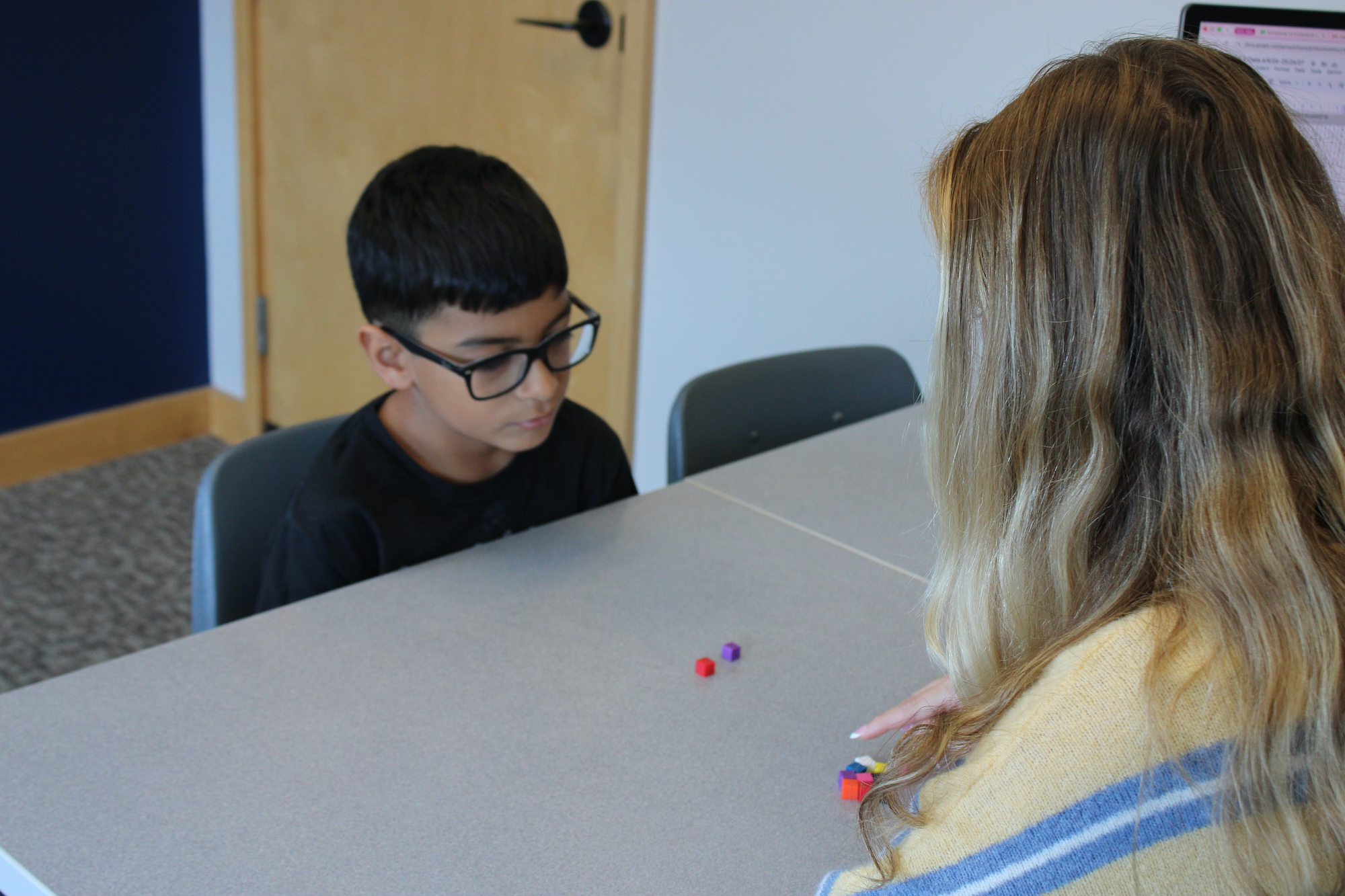
A common saying among math educators is that number sense is “caught, not taught.” This means that parents and teachers need to provide experiences. For example, if we tell a story such as, “I saw 3 birds in the tree, and 2 of them flew away, and there was 1 left,” we let children picture amounts instead of just digits. In the same way, we want to give kids practical experiences with concrete materials, hands-on activities, and games.
Use Visuals and Manipulatives to Help Children Create and Model the Problem
We want to help kids move past counting. Visuals in math show kids how numbers compare and connect, so they help kids see the relationships between numbers. A variety of visuals works best. Examples include ten frames, a rekenrek (a math counting frame that uses beads), items in groups, and base ten blocks.
A rekenrek has two rows of 10 beads. Each row has 5 red beads and 5 white beads, which helps students visualize the benchmark numbers 5 and 10. Students slide the beads left and right, and you can find many free virtual rekenreks online. At home, you can say or show a number and ask your child to represent it on the rekenrek. You can also show a number for a few seconds and ask what number they saw. Then try using the rekenrek to model addition and subtraction problems.
Ten frames are another great visual for working with the benchmark numbers 5 and 10. Children can also use them to visualize addition and subtraction. In the upper grades, ten frames help children quickly compare 2 digit numbers.
Here are a few more ideas for building number sense into your daily routines:
- Have your child compare prices when you shop at the grocery store.
- Ask your child to help plan a party, and have them estimate the number of guests and the amount of snacks needed.
- Let your child help measure out ingredients while you cook a recipe.
Frequently Asked Questions
What age does number sense start developing?
Number sense begins in the early years, as children learn to count, compare amounts, and notice how many are in a group. It keeps developing through the school years, and everyday experiences help build it along the way.
How do I know if my child is struggling with number sense?
Signs can include counting by memory without understanding quantity, needing to recount a group to say how many, or finding it hard to estimate or compare numbers. If you’re concerned, talk with your child’s teacher or a learning specialist.
Do we need special math tools at home?
No. Everyday items like snacks, coins, or blocks work well, and you can find free virtual rekenreks and ten frames online. Still, what matters most is giving your child regular, hands-on chances to see and talk about numbers.
How ETLC Can Help
Number sense is the foundation of mathematics, and it grows through hands-on experiences with manipulatives, visuals, and everyday math. You don’t have to figure out the right activities on your own, so if you’d like help with your child’s number sense, our team is here. Enrichment Therapy & Learning Center has locations in Johnston and North Liberty, IA, with virtual services also available.
Learn more about tutoring and academic support at ETLC or schedule a free consultation to talk with a member of our team.
You may also find these pages helpful:
- Practice Math Facts at Home: A Visualization Trick
- Fun Ways to Build Math Skills at Home
- Four Ways to Make Math Fun
About the Author
Sonia Strueby, M.A., CCC-SLP, is the founder of Enrichment Therapy & Learning Center. With over 25 years of experience as a speech-language pathologist, Sonia has dedicated her career to helping children overcome complex communication and academic challenges. She has advanced training and a special focus on treating dyslexia and childhood apraxia of speech, and she is passionate about providing families with a clear path to success.
0 Comments