

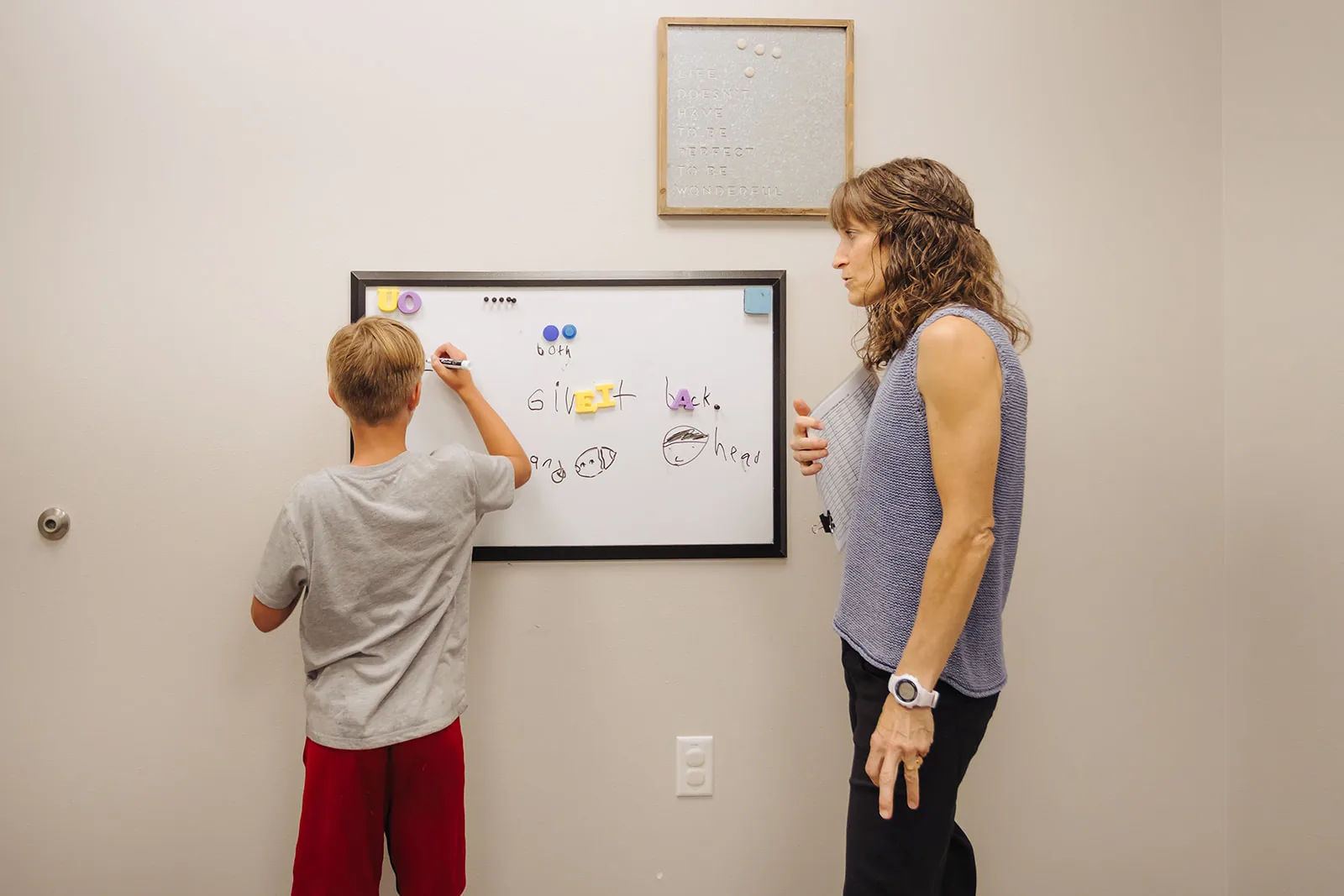
Writing is one of the most cognitively demanding tasks we ask children to do. Think about everything it requires at once: planning what to say, holding ideas in working memory, converting thoughts into words, forming letters correctly, spelling accurately, applying grammar rules, and editing the final product — all simultaneously.
For children with learning differences, executive functioning challenges, or handwriting difficulties, that simultaneous demand can feel completely overwhelming. It's not that they don't have ideas or don't care. It's that the process of getting those ideas onto paper requires more cognitive effort than they have available.
If your child shuts down, avoids writing, or produces work that doesn't reflect what you know they're capable of — this guide is for you.
Why Is Writing So Hard?
Writing draws on nearly every executive functioning skill at once:
- Planning — deciding what to say and in what order
- Working memory — holding the idea in mind while forming each sentence
- Attention — staying focused on the task without getting derailed
- Organization — structuring information logically
- Cognitive flexibility — shifting between generating ideas and monitoring mechanics
- Self-monitoring — checking spelling, grammar, and whether the writing makes sense
When one or more of these skills is underdeveloped, writing becomes a multi-front battle. A child who struggles with working memory may forget what they wanted to say halfway through a sentence. A child with attention difficulties may drift away from the topic. A child with handwriting challenges may spend so much mental energy on letter formation that they lose track of what they were writing about entirely.
This is why children with learning differences often describe writing as "too hard" or "too much" — because for them, it genuinely is.
Breaking Writing Assignments Into Manageable Steps
The most effective strategy for children who struggle with writing is breaking the task down into smaller chunks — removing the overwhelm by making each step doable on its own.
Here's an example of how to break down a common assignment:
Task: Read Chapter 3 (pages 40–55) and answer ten questions in complete sentences. Due at the end of the week.
Day 1 — Read and retell:
- Read the directions and questions before reading the text — what does your child need to understand as they read?
- Read pages 40–45, then pause and have your child tell you what happened (or record themselves on a phone or tablet)
- Read pages 46–50 and repeat
- Read pages 51–55 and repeat
Day 2 — Answer questions 1–5: If your child struggles to get thoughts onto paper, have them record their answer first, then play it back and transcribe while listening. Google Docs also offers a free speech-to-text feature that allows children to dictate their answers and edit from there.
Day 3 — Answer questions 6–10: Same process. Keep sessions short — 20 to 30 minutes — and take a break before editing.
Day 4 — Edit: Check for complete answers, spelling, and missing work. Children with learning differences need dedicated editing time, not a rushed final scan. Build it into the schedule rather than treating it as optional.
Day 5 — Submit and feel confident.
This approach takes a task that feels impossible and turns it into five small, manageable steps. Over time, children begin to internalize this kind of planning on their own.
Helpful Tools for Young Writers
Several tools can reduce the friction of writing without removing the learning:
✓ Voice recording — recording an answer before writing allows the child to focus on content first and transcription second
✓ Speech-to-text — Google Docs' free dictation feature is a powerful tool for children who have ideas but struggle to get them on paper
✓ Graphic organizers — visual frameworks that help children plan before they write, reducing the cognitive load of organizing ideas in real time
✓ Sentence starters — providing the first few words of each sentence reduces the "blank page" paralysis many struggling writers experience
✓ Shortened assignments — for some children, demonstrating understanding through fewer, higher-quality responses is more appropriate than completing a full set of questions
Why Handwriting Matters — and What to Do When It's Struggling
In an age of tablets and keyboards, it can be tempting to dismiss handwriting as a low priority. But research consistently shows that children who struggle with handwriting face challenges beyond just messy letters.
When a child has to devote significant mental effort to forming letters, they have less cognitive capacity available for the actual content of their writing — the ideas, organization, and language. Slow, effortful handwriting also tends to correlate with difficulty typing later on, because many of the underlying skills (working memory, motor planning, attention) are shared.
Signs your child may be struggling with handwriting:
- Letter formation that is inconsistent or difficult to read
- Frequent letter reversals (b/d, p/q, 9/p) beyond second grade
- Writing that is significantly slower than peers
- Physical complaints during writing (hand fatigue, cramping)
- Avoiding written tasks or becoming distressed when asked to write
- Written output that doesn't reflect their verbal ability
What Is Handwriting Without Tears?
At ETLC, our learning specialists and speech-language pathologists are trained in Handwriting Without Tears (HWT) — a multisensory handwriting program from Learning Without Tears that teaches letter formation in a logical, structured sequence.
HWT groups letters by the way they're formed rather than alphabetically. For example, the "diver letters" — lowercase b, p, m, n, r, and h — all start at the top and "dive down" before completing the rest of the stroke. Teaching letters in formation groups reduces confusion and helps children develop consistent, automatic letter production.
HWT is appropriate for students from pre-K through middle school, with adaptations available for older learners. It's used in both tutoring and speech-language therapy sessions, depending on a child's specific needs.
Building Pre-Writing Skills in Young Children
For children younger than pre-K, formal handwriting instruction isn't appropriate — but many play activities naturally build the foundational skills that make handwriting easier later on:
- Drawing with sidewalk chalk or large crayons on paper
- Playing with magnetic fishing rods, puzzles, or building blocks
- Activities that develop body and spatial awareness
- Any fine motor play: threading beads, using tongs, cutting with scissors
Simply playing with your child and incorporating these kinds of activities builds the grip strength, motor planning, and visual-spatial skills that handwriting eventually requires.
When to Consider an Occupational Therapist
Some handwriting difficulties point to needs beyond what a learning specialist or SLP can address. If your child shows signs of poor grip strength, difficulty with posture during writing, or significantly reduced visual-motor integration, a referral to an occupational therapist (OT) is worth discussing. OTs specialize in the sensory and motor foundations of handwriting and can provide evaluation and intervention for children who need that level of support.
The Benefits of Journaling
One of the lowest-pressure ways to build writing skills at home is through journaling — and the benefits extend well beyond mechanics.
Writing fluency. The more a child writes, the easier writing becomes. Regular journaling builds stamina, reduces the cognitive effort of transcription over time, and helps children find their voice as writers.
Self-editing habits. When a child reads back what they've written, they naturally begin to notice when something doesn't make sense. This habit of self-review is a foundational editing skill that transfers to academic writing.
Emotional expression. Writing gives children a private space to process thoughts and feelings — particularly useful for children who struggle to verbalize emotions. Reducing internal stress through writing can also reduce the emotional activation that makes writing tasks feel impossible.
For children who aren't ready to write — drawing pictures with a caption or dictating to a parent who writes it down offers the same expressive benefits while building toward written expression at the child's own pace.
Keep journals low-stakes. No grades, no corrections, no required topics. The goal is habit and confidence, not polish.
Frequently Asked Questions
My child has great verbal ideas but can't get them on paper. What's going on? This disconnect between verbal ability and written output is one of the most common and frustrating writing challenges. It often points to working memory difficulties, difficulty with the motor demands of writing, or the cognitive load of managing mechanics while generating content simultaneously. Recording answers first and transcribing second — or using speech-to-text — can bypass this bottleneck while the underlying skills are being built.
How do I know if my child's handwriting difficulty needs professional support? If your child's handwriting is significantly difficult to read, if they complain of pain or fatigue during writing, if letter reversals persist beyond second grade, or if their written output is dramatically below what you'd expect given their verbal ability — those are signals worth discussing with a learning specialist or SLP. An evaluation can clarify whether HWT, OT, or another approach is the right fit.
At what age should handwriting be automatic? Most children develop reasonably automatic handwriting by the end of second or third grade. By that point, writing should feel fluent enough that they can focus primarily on content rather than letter formation. Children who are still laboring over individual letters in third grade or beyond benefit from targeted handwriting support.
Does typing replace the need for handwriting? For many children, typed output eventually becomes their primary writing modality — and that's okay. But learning to write by hand first builds foundational motor planning, working memory, and attention skills that support typing fluency later. Most educators recommend developing handwriting skills before transitioning heavily to keyboards.
How ETLC Can Help
If your child is struggling with writing assignments, handwriting, or the executive functioning skills that make writing possible, our team can help identify what's at the root and build a plan that works.
Learn more about our Tutoring and Academic Support services orschedule a free consultation to talk with a member of our team.
You may also find these pages helpful:
About the Author
Sonia Strueby, M.A., CCC-SLP, is the founder of Enrichment Therapy & Learning Center. With over 25 years of experience as a speech-language pathologist, Sonia has dedicated her career to helping children overcome complex communication and academic challenges. She has advanced training and a special focus on treating dyslexia and childhood apraxia of speech, and she is passionate about providing families with a clear path to success.

0 Comments