

B and d confusion is one of the most common letter mix-ups in early readers, and in most cases it is a normal part of learning to read rather than a red flag. Because “b” and “d” are mirror images, a young child’s brain has to work harder to tell them apart than it does with most other letters. The good news is that a few simple, multisensory tricks can help your child build that distinction quickly.
Below are seven strategies, a speed and accuracy game, and guidance on when to ask for extra support.
Why Does B and D Confusion Happen?
Early readers are still learning that letter direction matters. A chair is a chair whether it faces left or right, but with letters, direction changes the sound completely. Since “b” and “d” are the same shape flipped, they are the pair most likely to trip kids up, especially between ages 4 and 7, while visual discrimination and reading skills are still developing.
Is B and D Confusion a Sign of Dyslexia?
Not on its own. Letter reversals are extremely common in kindergarten and first grade, and most children outgrow them with practice. According to reading experts featured by Reading Rockets, there is no evidence that children with dyslexia actually see letters backwards. Instead, specialists look for difficulty with the sounds inside words, such as struggling to hear that “mat” is made of three sounds: /m/ /a/ /t/.
That said, if reversals are frequent, last past age 7 or 8, or come with other reading struggles, an evaluation is worthwhile. Our guide to the signs of dyslexia explains what to watch for.
Seven Tricks to End B and D Confusion
These tricks work for most children with b and d confusion. Try one or two, and then practice consistently. Repetition, not the number of tricks, is what makes it stick.
Picture It With Objects
- Bat and ball trick: The letter “b” is made of a bat and a ball. As you write it, say “bat, ball, buh,” like this: “First you grab the bat, then you hit the ball.”
- Doorknob and door trick: The letter “d” is made of a doorknob and a door. As you write it, say “doorknob, door, duh,” like this: “First you grab the doorknob, then you open the door.”
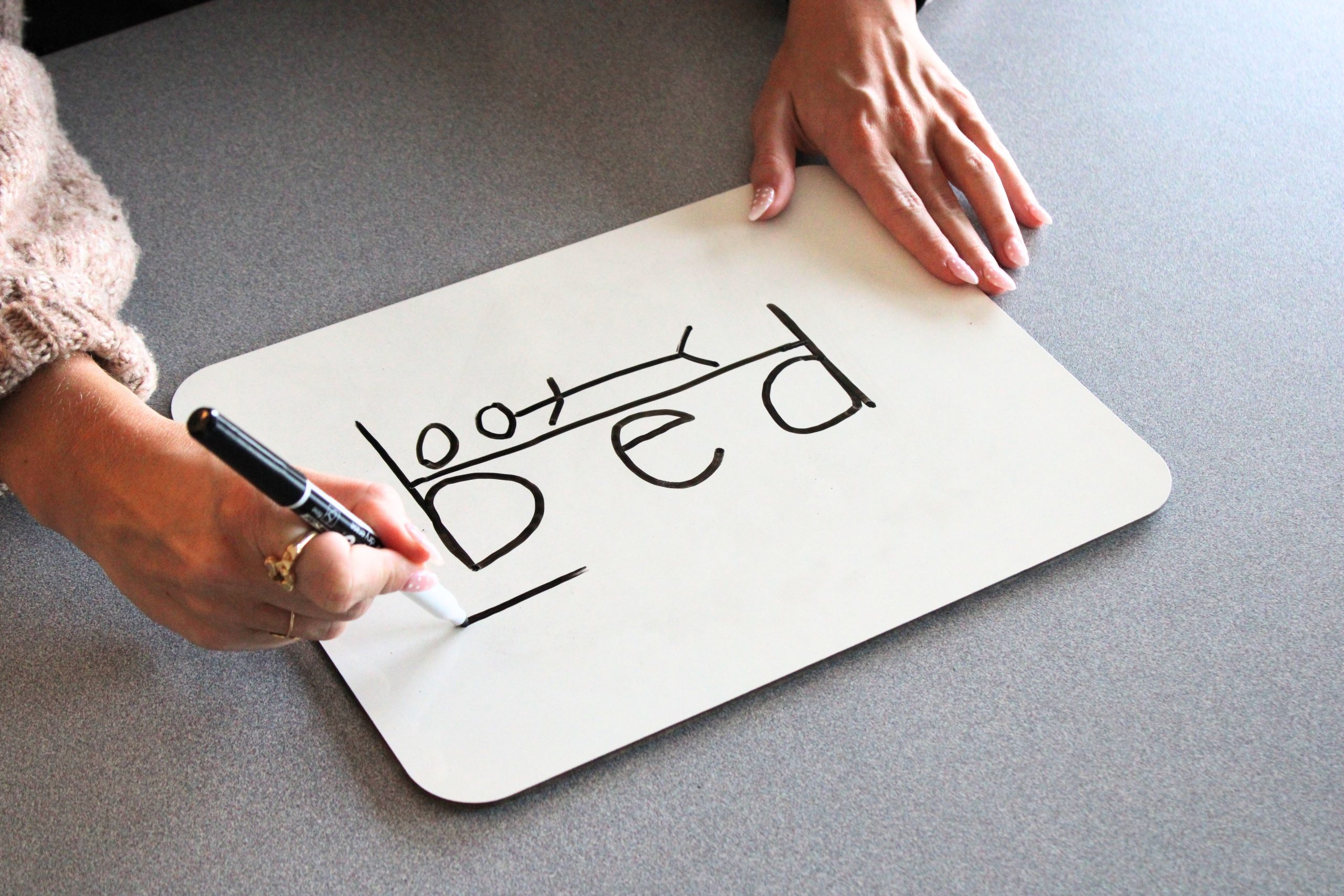
- Bed trick: Draw a simple bed using both letters. The “b” is the headboard and makes the first sound in “bed,” while the “d” is the footboard and makes the last sound.
Saying the phrase out loud while writing connects the shape, the sound, and the motion together.
Use Rules and Hands
- Belly and diaper rule: Reading from left to right, the front side of “b” has an arch like a belly, and the back side of “d” has an arch like a diaper. Ask your child which side of the line the arch falls on. First practice with flashcards, and then move to words such as big and dig, and bill and dill.
- C makes D rule: When we write “d,” we first write a “c” that turns into a tall letter. Ask, “Which letter has the c in it?” The answer is always “d.”
- Fist trick: Have your child make fists with both hands and stick out the thumbs, palms facing away. The left hand forms a lowercase “b” and the right hand forms a “d,” so together they spell “bed” from left to right, just like on the page.
- Hand trick while reading: If your child gets stuck on a letter, they can quickly form both letters with their hands, match one to the paper, and then name the letter.
How to Practice These Tricks
- Say the phrase out loud every time your child writes or reads the letter, not just occasionally.
- Practice during handwriting time too, since writing the letter reinforces the motor pattern.
- Keep sessions short and low pressure, because a minute or two of focused practice beats a long drill.
- Praise effort and progress, not just correct answers.
Build Speed and Accuracy With Movement
Once your child can identify the letters, it is time to work on speed and accuracy. Create a chart with a mix of “b” and “d” in random order, and hang it on the wall. Have your child stand three to five feet away and say the sound each letter makes, not the letter name. Start on a different line each day so your child does not memorize the pattern, and do only four or five lines at a time. If your child is frustrated, do two or three and build up from there.
Four Levels of Practice
- Level 1: Stand in front of the chart and say the sounds.
- Level 2: Say the sounds to a metronome beat, and gradually increase the rate until it is challenging but not frustrating.
- Level 3: Add a physical movement, such as jumping on a mini-trampoline, with one sound for each jump. If that is too hard, say one sound for every two jumps.
- Level 4: Jump with legs out for /b/ and feet together for /d/. This gets both sides of the brain working together, and it is not easy.
When your child is comfortable, change the movement, such as front and back for “b” and apart for “d,” or scissors for “b” and together for “d.” Make it harder by putting the letters into syllables, and later into words. You can also add “p” to the mix, because it is another letter that children often confuse with “b” and “d.”
When Should I Seek Help?
If your child still mixes up “b” and “d” past age 7 or 8, if the confusion affects reading fluency or confidence, or if you notice other reading or writing challenges, it is a good time to have their skills evaluated. Early support makes a real difference, and a screening simply helps you understand what is going on. You do not need to wait until you are certain something is wrong. Our post on a child struggling with reading can help you decide.
Frequently Asked Questions
At what age should my child stop reversing b and d?
Most children stop by age 7 or 8. Reversals in kindergarten and first grade are very common, so they are usually not a concern at that stage.
Do letter reversals mean my child has dyslexia?
No, not by themselves. Dyslexia is identified by difficulty with the sounds in words and with decoding, so reversals matter only when they come with other reading struggles.
Which trick works best for b and d confusion?
It depends on the child. Some prefer the bed picture, while others like the hand trick, so try one or two and stay consistent. For more letter practice ideas, see our post on building early literacy skills.
How ETLC Can Help
If you have questions about your child’s reading development, our team is here to help. Enrichment Therapy & Learning Center has locations in Johnston and North Liberty, IA, with virtual services also available.
Learn more about dyslexia therapy at ETLC or schedule a free consultation to talk with a member of our team.
You may also find these pages helpful:
About the Author
Sonia Strueby, M.A., CCC-SLP, is the founder of Enrichment Therapy & Learning Center. With over 25 years of experience as a speech-language pathologist, Sonia has dedicated her career to helping children overcome complex communication and academic challenges. She has advanced training and a special focus on treating dyslexia and childhood apraxia of speech, and she is passionate about providing families with a clear path to success.

0 Comments