

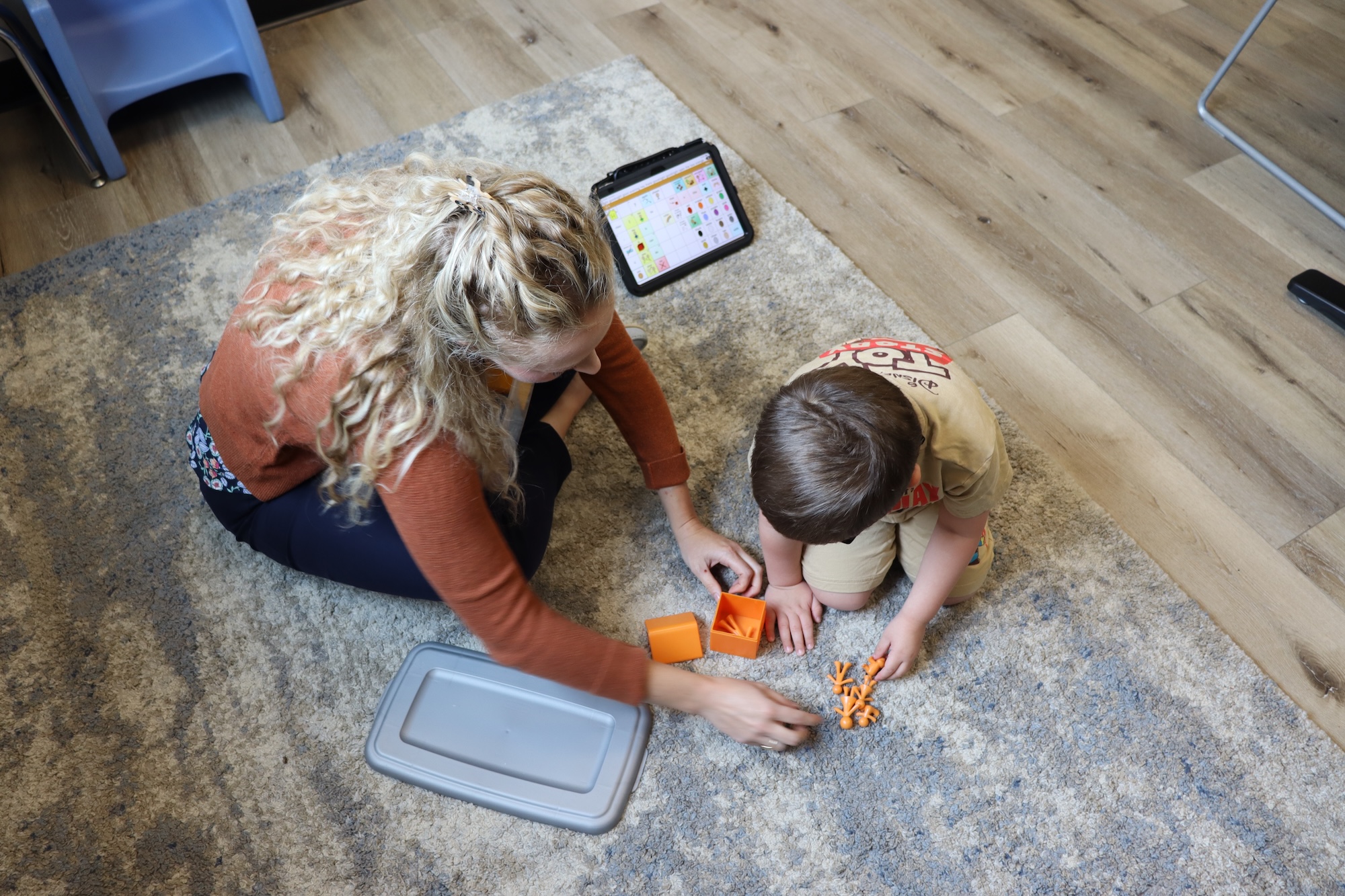
You can use everyday objects for speech practice almost anywhere, with items you already have at home. No special toys, worksheets, or therapy room required. With a few strategies from your child’s speech-language pathologist (SLP), moments like snack time, cooking, or a walk to the car can become real opportunities for your child’s communication skills to grow.
Why Does Practice Outside the Therapy Room Matter?
A weekly session, even a great one, isn’t enough on its own. For your child’s communication skills to grow at the pace they can, that progress needs reinforcement outside the therapy room too. Research supports this: a meta-analysis published in the American Journal of Speech-Language Pathology found that parent-implemented language interventions can be an effective way to build children’s language skills, alongside the work happening in formal therapy. When your SLP teaches you a strategy, using it consistently at home helps it stick.
What Everyday Objects Can I Use to Practice Speech and Language Skills?
You don’t need anything fancy. An ordinary cup, for example, can target four different skill areas at once:
- Prepositions: Hide a small object, like a mini M&M, inside, behind, or under the cup. See if your child can follow your direction to find it, then describe where they found it.
- Action words: A cup can roll, get washed, fall off the table, or be turned over and drummed on with a spoon. Naming what’s happening builds vocabulary in the moment.
- Phonological awareness (pre-reading skills): Ask your child how many sounds they hear in “cup” (C-U-P), whether they can think of a word that rhymes with it, or how many syllables a “sippy cup” has. (It’s three!)
- Speech sounds: Have your child practice five words containing whatever sound they’re working on in therapy. As a reward, let them try shooting a grape into the cup from across the table.
A cup is just one example. Almost any object around the house can be used the same way to target language or articulation goals. Here are a few more.
Phones or Tablets
Take a short video of your child doing an activity, then watch it back together and ask, “What did you do?” This is a natural way to practice past-tense verbs, either the regular “-ed” ending (“You jumped up and down”) or an irregular form (“You ate an apple”). If your child isn’t using past tense on their own yet, simply model it for them while you watch.
Cooking Directions
Cooking together is a built-in way to practice following directions and listening comprehension. Start with two- or three-step directions, like “Put two cups of flour and one cup of sugar into the bowl,” and simplify to one step at a time if that’s too much. Many children begin following simple two-step directions around age 3, with three-step directions often developing over the following year or two, so adjust based on where your child is right now. Afterward, ask your child to describe the steps back to you. This builds sequencing and short-term memory skills too.
A Mystery Bag or Box
Fill a bag with household objects that aren’t yet part of your child’s vocabulary. Kids love taking turns pulling items out. Label new words for them at first, then, once they’ve had time to practice, see if they can name each item on their own. If they get stuck, offer hints such as the first sound of the word, what it’s used for, or where it’s usually found.
Books
Regular reading brings its own language benefits, and you can also use books to target a specific goal. To work on articulation, choose a book with a main character whose name starts with your child’s target speech sound, and you’ll naturally model that sound throughout the story. Some familiar books also repeat one sound often. “Row, Row, Row Your Boat,” for instance, offers lots of natural models of the initial /r/ sound.
How Can I Practice Speech and Language Skills While Out and About?
Errands and car rides count too. If you spot a semi-truck in a parking lot, that’s a whole conversation waiting to happen. You could:
- Predict together where the truck might be headed next.
- Talk about what it might be carrying.
- Point out shapes, like circular wheels and a rectangular trailer.
- Compare size: “Is it bigger or smaller than our car? How long do you think it is?”
- Describe its colors.
- Discuss movement: the wheels turn, and it can go forward, backward, fast, or slow.
- If your child is working on the /k/ sound at the end of words, use the word “truck” often with a little extra emphasis on that final sound.
Any topic your child is genuinely interested in works the same way. The more motivating the object or activity, the more productive the conversation tends to be. It doesn’t have to be all questions, either. Make your own observations out loud too, because narrating what you notice models language in a way that invites your child to do the same.
Frequently Asked Questions
How often should we practice at home?
Short and frequent works well. A few minutes during routines you already have, like meals, bath time, or car rides, is often easier to keep up than a long practice session. Your child’s SLP can tell you how much practice fits your child’s goals.
What if my child gets frustrated during practice?
Keep it light and brief. If your child seems tired or discouraged, switch to a game, model the word for them instead of asking them to say it, or try again later. Practice should feel like play, not a test.
How do I know which skills to work on?
Your child’s SLP can recommend targets based on your child’s goals. If your child isn’t in therapy and you’re unsure where to start, a speech and language evaluation can show where they stand and what to focus on next.
How ETLC Can Help
Practice at home works best when it lines up with what your child is doing in therapy, and you don’t have to guess which strategies to use. If you have questions about your child’s speech or language development, our team is here to help. Enrichment Therapy & Learning Center has locations in Johnston and North Liberty, IA, with virtual services also available.
Learn more about speech-language therapy at ETLC or schedule a free consultation to talk with a member of our team.
You may also find these pages helpful:
- Speech Sound Disorders at ETLC
- Language Disorders at ETLC
- Practicing Speech Sounds at Home: How You Can Help
About the Author
Sonia Strueby, M.A., CCC-SLP, is the founder of Enrichment Therapy & Learning Center. With over 25 years of experience as a speech-language pathologist, Sonia has dedicated her career to helping children overcome complex communication and academic challenges. She has advanced training and a special focus on treating dyslexia and childhood apraxia of speech, and she is passionate about providing families with a clear path to success.
0 Comments