

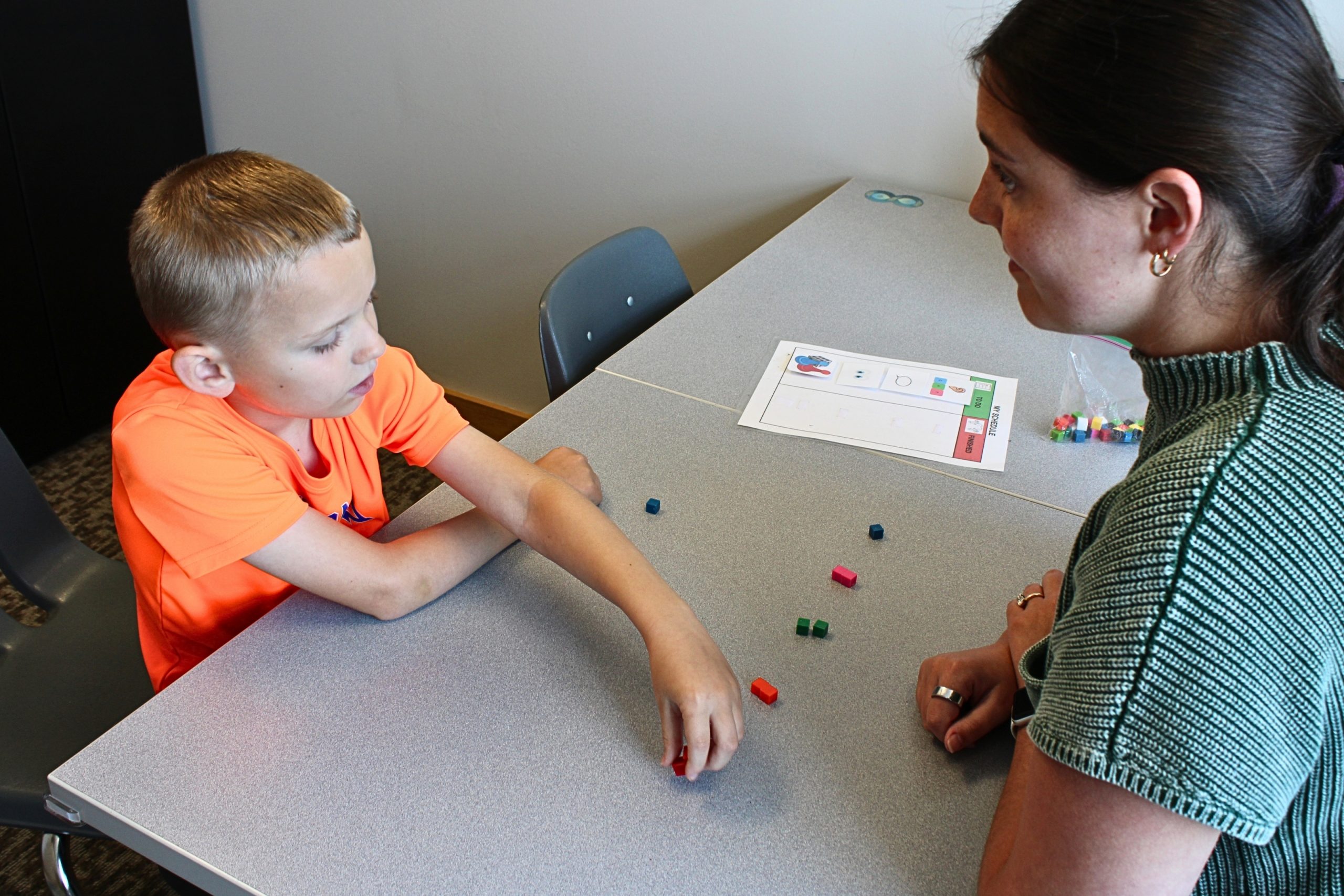
The phonological awareness hierarchy breaks a key reading skill into 12 building blocks, from rhyming up to changing the sounds in words. Knowing the order, and the grade when children usually master each step, helps you see where your child is and what comes next. Every child develops at their own rate, so use this as a guide, not a deadline.
What Is Phonological Awareness?
Phonological awareness is a metacognitive skill that involves thinking about the sounds in words, the syllables in words, and the words that make up sentences. The phonological awareness hierarchy breaks this skill into building blocks: breaking apart words into sounds or syllables, putting sounds or syllables together to create words, and manipulating the sounds and syllables in words.
When working on phonological awareness, focus on the sounds in words rather than the letters. For example, we spell “gate” with four letters, G-A-T-E, but we say “gate” with three sounds, G-AY-T.
Why Is Phonological Awareness Important?
Phonological awareness is the foundation for being able to decode words and ultimately read fluently. According to the International Dyslexia Association, dyslexia often results from a breakdown or lack of phonological awareness skills. Our guide to what phonological awareness is and why it matters for reading explains more.
The Phonological Awareness Hierarchy by Grade Level
The hierarchy lets us build skills gradually, beginning with simple tasks and working up to more complex ones. Each table below lists the tasks from most to least challenging, with the grade when children usually master them.
Phoneme-Level Skills
These skills involve working with individual sounds, and they tend to be the most challenging in the hierarchy.
| Task | What It Means | Example | Typically Mastered |
|---|---|---|---|
| Manipulation of phonemes | Changing or moving sounds to make a new word | “Replace the /t/ sound in tuck with the /d/ sound.” (duck) | Second grade |
| Addition of phonemes | Adding a sound to make a new word | “Say nail with the /s/ sound at the beginning.” (snail) | First to second grade |
| Deletion of phonemes | Removing a sound to make a new word | “Say slip without the /l/ sound.” (sip) | First to second grade |
| Segmentation of phonemes | Breaking a word into individual sounds | “What sounds make up the word fish?” (/f/ /i/ /sh/) | First grade |
| Blending of phonemes | Putting sounds together to make a word | “What word do these sounds make: /p/ /i/ /g/?” (pig) | First grade |
| Identification of phonemes | Naming the beginning, middle, or ending sound | “What sound is at the beginning of the word soup?” (/s/) | Kindergarten to first grade |
Syllable, Word, and Rhyme-Level Skills
These skills build on larger chunks of language, so they are generally easier and develop earlier than phoneme-level skills.
| Task | What It Means | Example | Typically Mastered |
|---|---|---|---|
| Deletion of syllables | Removing a syllable to make a new word | “Say doghouse without dog.” (house) | Kindergarten |
| Segmentation of syllables | Breaking a word into syllables | “How many syllables are in the word potato?” (3: po, ta, to) | Kindergarten |
| Blending of syllables | Combining syllables to make a word | “What word do these parts make: cow, boy?” (cowboy) | Kindergarten |
| Segmentation of words in sentences | Breaking a sentence into words | “How many words are in the sentence: I like to eat spaghetti?” (5) | Kindergarten |
| Production of rhyming words | Making a rhyming word | “What rhymes with cat?” (bat) | Kindergarten |
| Discrimination of rhyming words | Deciding which words rhyme | “Does cat rhyme with hat or dog?” (hat) | Preschool to kindergarten |
Why Tracking This Timeline Matters
According to ASHA’s typical speech and language development milestones, phonological awareness skills like these build the foundation for reading success in the early elementary years. As a result, tracking where your child falls on this timeline can help you catch gaps early, before they affect reading progress. Remember that these ranges reflect typical development, so some variation is normal and not automatically a cause for concern.
Frequently Asked Questions
What is the phonological awareness hierarchy?
It is the order in which children typically learn to work with sounds, from rhyming and syllables up to changing individual sounds in words. Each step builds on the one before it.
Where should I start if my child is struggling?
Go back to the last step your child can do easily, then practice the next one. If a child struggles to blend sounds, for example, make sure rhyming and syllable skills are solid first.
When should I worry about phonological awareness?
If your child is past the grade when most children master a skill and is still struggling, a screening can show whether extra support would help. Early support makes a difference.
How ETLC Can Help
Does your child seem to be struggling through the steps of the hierarchy? We can help. Enrichment Therapy & Learning Center has locations in Johnston and North Liberty, IA, with virtual services also available.
Learn more about dyslexia and reading support at ETLC or schedule a free consultation for a screening and to talk with a member of our team.
You may also find these pages helpful:
- What Is Phonological Awareness and Why Does It Matter for Reading?
- How to Teach Your Child Decoding Skills
- Reading Nonsense Words
About the Author
Sonia Strueby, M.A., CCC-SLP, is the founder of Enrichment Therapy & Learning Center. With over 25 years of experience as a speech-language pathologist, Sonia has dedicated her career to helping children overcome complex communication and academic challenges. She has advanced training and a special focus on treating dyslexia and childhood apraxia of speech, and she is passionate about providing families with a clear path to success.


0 Comments