

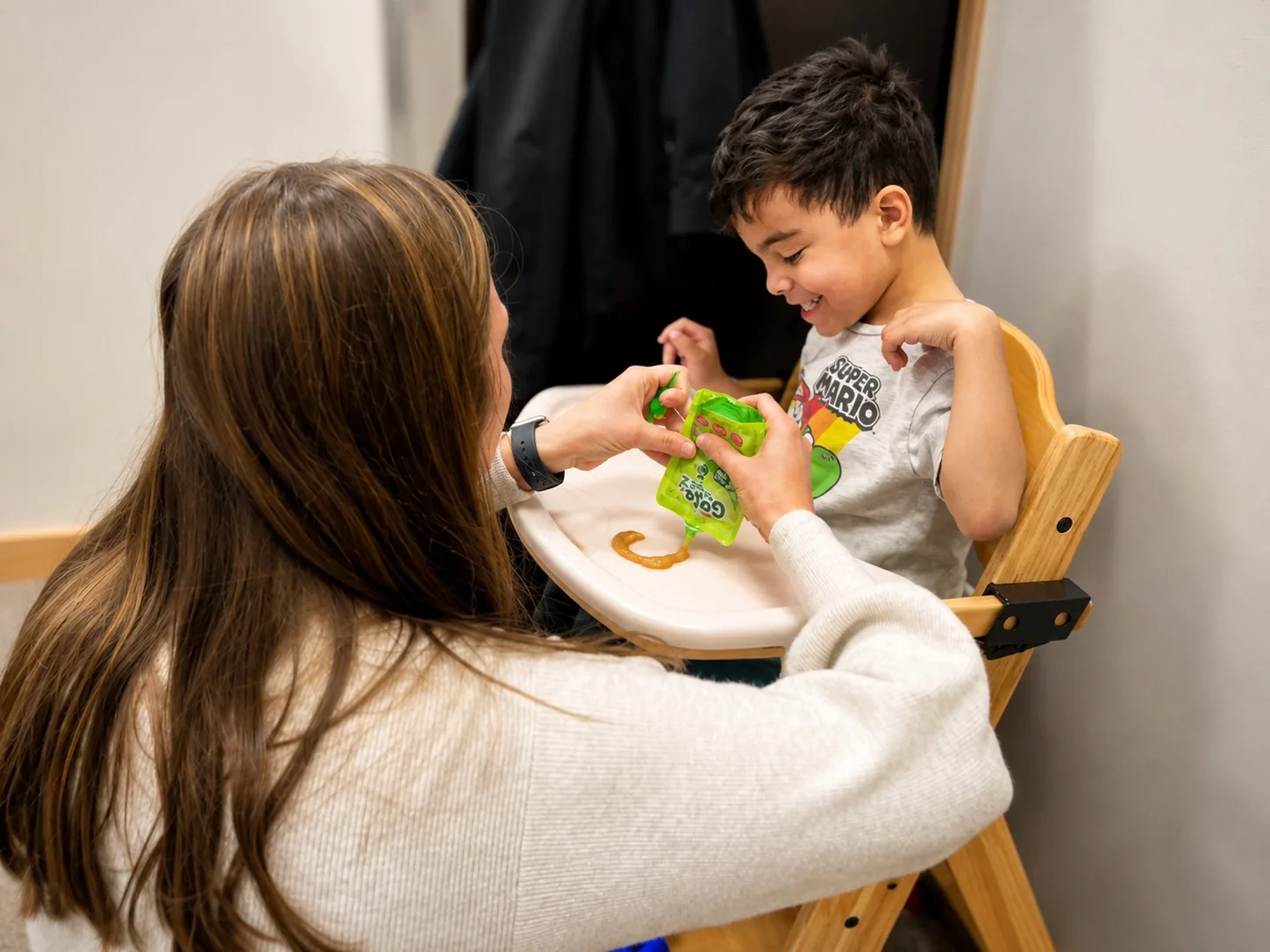
Almost every parent has dealt with a child who refuses vegetables, insists on the same meal every night, or melts down when a familiar food looks slightly different than usual. Some degree of food selectivity is completely normal in young children.
But there's a meaningful difference between a child who is a typical picky eater and a child who has a true feeding difficulty — and knowing the difference can help you figure out what kind of support, if any, your child might need.
This guide covers food jags, practical strategies for expanding your child's diet, the role of proper mealtime seating, and how to navigate high-pressure eating situations like holiday meals.
What Is a Food Jag?
A food jag is when a child fixates on one specific food — often a very specific version of that food — and refuses to eat almost anything else. The classic example: "My child will only eat Kraft mac and cheese. Turtle-shaped. And it has to be that exact brand."
Food jags are common in households with very picky eaters, and they create a particular kind of worry for parents and feeding therapists alike: what happens when the child burns out on that one food? If there's no backup, mealtimes become a crisis.
The goal with a food jag isn't to abruptly remove the preferred food — that approach usually backfires. Instead, the strategy is to gradually modify the food your child already accepts, expanding their tolerance one small step at a time.
How to Expand a Food Jag: The Shape-Color-Taste-Texture Method
When a child is stuck on one specific food, make changes in this order — and spend at least two weeks on each step before moving to the next. Rushing creates resistance; gradual exposure builds tolerance.
Step 1: Shape
For many foods, changing the shape is the easiest first step. Use cookie cutters to cut bread, cheese, or pancakes into new shapes. For pasta-based foods, offer a bowl that's mostly the familiar shape with a few new shapes mixed in. Gradually shift the ratio until the bowl is entirely the new shape.
Let your child help. Children who participate in the change are far more willing to accept it.
Step 2: Color
Add a few drops of food coloring to a familiar food and let your child choose the color. This sounds minor — but for many children, the novelty of a pink pancake or blue mashed potatoes is genuinely exciting rather than threatening. Over time, it loosens the rigidity around food needing to look exactly right.
Step 3: Taste
Introduce small taste variations through dips, sauces, and preparation methods. Offer ketchup, ranch, hummus, or cheese sauce on the side. Try the same food baked vs. roasted, or toasted vs. microwaved. The underlying food stays familiar while the flavor experience gently shifts.
Step 4: Texture
Texture is often the most challenging dimension for picky eaters — and it's typically addressed last. Pasta cooked for a shorter or longer time, bread with different amounts of butter, cheese slightly melted vs. cold — small texture variations introduced slowly build tolerance over time.
Throughout all four steps, keep the tone light and the pressure low. The goal is exposure, not consumption. Research consistently shows that children need exposure to a food 10 or more times before they're likely to try it — and exposure includes seeing, smelling, and touching, not just eating.
The Role of Proper Mealtime Seating
One factor that significantly affects how well a child eats — and is almost always overlooked — is how they're seated at the table.
If a child doesn't have proper physical stability while sitting, their body is working hard just to stay upright and balanced. That leaves very little attention available for the actual work of eating: hand-to-mouth coordination, chewing, and swallowing.
The 90-90-90 position is the gold standard for mealtime seating:
- 90-degree angle at the hips
- 90-degree angle at the knees
- 90-degree angle at the ankles
The child should be seated far enough forward that their knees are over the edge of the seat, and the table or tray should fall between belly button and chest height.
Simple ways to achieve this at home:
✓ Booster seat — raises a smaller child to the right height at the table
✓ Footrest — if feet are dangling, a child has no sense of stability. Duct-tape phone books together or use a sturdy step stool to create the right height
✓ Wedge behind the chair — a styrofoam wedge from a craft store angled behind the seat back helps a child sit forward enough
✓ Shelf liner on the seat — prevents sliding and gives the child a stable, grounded feeling
Proper positioning supports breathing, promotes a feeling of safety, and dramatically improves hand-to-mouth coordination and chewing. It's a small adjustment that makes a surprisingly large difference.
Strategies for High-Pressure Eating Situations
Holiday meals, family gatherings, and restaurant visits can be especially stressful for families with picky eaters — because the food is unfamiliar, the environment is overwhelming, and there's often social pressure from well-meaning relatives.
Here's how to approach these situations with less stress for everyone.
Do a trial run before the event. A couple of weeks before a big holiday meal, offer one or two of the dishes your child is likely to encounter. They don't have to eat it — just seeing and smelling it repeatedly makes it less frightening when it appears on the actual table. Research shows that repeated exposure, even without tasting, increases the likelihood of eventual acceptance.
Experiment with textures in advance. In the days before the event, offer foods of varying textures — crunchy, mushy, pureed, cubed — and talk about how the same food can look different depending on how it's prepared. "Some people like mashed potatoes, some like baked. Both are potatoes!" This builds flexibility before the stakes are high.
Provide something familiar. Ensure there's at least one food your child reliably likes available at the meal. Having a safe option reduces anxiety for both the child and the parent — because you know they'll have something to eat, and they know they won't be completely stranded.
Get your child involved. Children who help prepare food are significantly more likely to try it. Let them wash vegetables, stir ingredients, set the table, or make place cards. Involvement creates ownership — and ownership creates curiosity.
Manage expectations with relatives. Let family members know in advance that your child is working on expanding their diet, and ask them not to comment on what your child is or isn't eating. Pressure and commentary — even well-intentioned — increase anxiety and make picky eating worse.
Keep the pressure off at the table. Use a division of responsibility approach: your job is to provide the food; your child's job is to decide what and how much to eat. Don't bribe, cajole, or celebrate dramatically when they try something new. A calm, matter-of-fact approach at the table does more for long-term progress than any amount of negotiating.
When Is Picky Eating a Feeding Disorder?
Picky eating becomes a clinical concern when it significantly affects a child's nutrition, growth, family functioning, or quality of life. Signs that a child may benefit from a feeding evaluation include:
- Eating fewer than 20 different foods total
- Refusing entire food groups (no proteins, no vegetables, no mixed textures)
- Gagging, vomiting, or extreme distress at the sight or smell of non-preferred foods
- Significant weight loss or failure to gain weight appropriately
- Mealtimes that are consistently distressing for the whole family
- A diet so limited that nutritional supplementation is required
These signs can point to a condition called Avoidant/Restrictive Food Intake Disorder (ARFID) or to sensory processing differences that affect how food feels in the mouth. Both can be addressed with the support of a feeding-specialized speech-language pathologist.
Frequently Asked Questions
How many times does a child need to be exposed to a food before trying it? Research suggests children may need exposure to a new food 10 to 15 or more times before they're willing to try it — and exposure includes seeing, smelling, touching, and being near the food, not just eating it. Patience and repeated low-pressure exposure are the keys.
Should I make my child try new foods at every meal? Forcing a child to eat or try a food typically increases resistance rather than reducing it. A more effective approach is regularly including new foods alongside familiar ones, without pressure to eat them. Over time, familiarity naturally builds tolerance.
My child eats fine at home but refuses food at school or elsewhere. Is that normal? Yes, this is very common. Familiar environments and familiar people make eating feel safer. Strategies that build tolerance at home — like the shape-color-taste-texture progression — gradually extend to other settings as the child builds confidence.
When should I see a feeding specialist? If your child's diet is so limited it's affecting their nutrition or growth, if mealtimes are consistently distressing, or if your child gags or vomits in response to non-preferred foods, a feeding evaluation with a speech-language pathologist is worth pursuing.
How ETLC Can Help
If your child's picky eating goes beyond typical toddler selectivity — or if mealtimes have become a source of significant stress — our team can help identify what's driving the difficulty and build a plan to address it.
Learn more about our Feeding and Swallowing services orschedule a free consultation to talk with a member of our team.
You may also find these pages helpful:
About the Author
Sonia Strueby, M.A., CCC-SLP, is the founder of Enrichment Therapy & Learning Center. With over 25 years of experience as a speech-language pathologist, Sonia has dedicated her career to helping children overcome complex communication and academic challenges. She has advanced training and a special focus on treating dyslexia and childhood apraxia of speech, and she is passionate about providing families with a clear path to success.


0 Comments